"Top floor," I said. "Now."
Chairs pushed back. Boots hit the stairs. Nobody asked why.
The upper room was small. It had been an officer's quarters once. The ceiling was low enough that Henrik had to duck through the doorframe.
I closed the door behind the last Knight. Then the window. Then I checked the corridor. Empty.
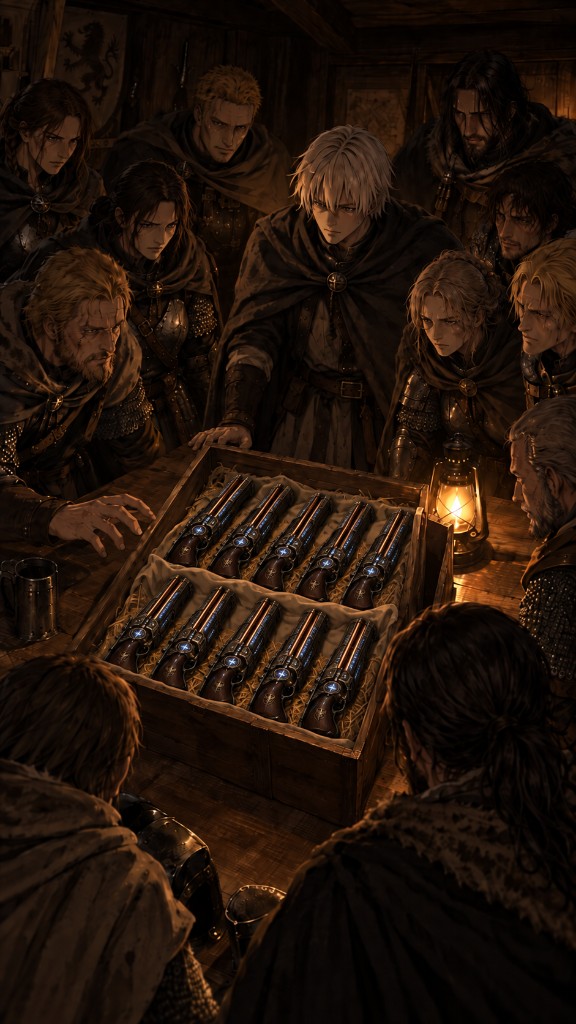
The room held the eleven of them in a rough semicircle around the central table. A single mana-glow lamp on the desk.
"I know you're tired," I said. "I know some of you haven't slept properly in two weeks. I'd give you the night if I could."
Henrik leaned against the wall with his arms crossed. Dorn sat at the edge of the table.
"Our timeline doesn't allow it," I continued. "And what I'm about to tell you cannot leave this room."
The room went still.
"If any detail of this briefing reaches anyone outside these walls it will be traced back to one of us. And the person responsible will face summary judgment under Iron Cross operational law."
Nobody shifted.
Good.
"Some of you served with me at Qalathar," I said. "You saw what happened with Eckhardt."
Henrik's jaw tightened. Dorn's fingers stopped moving on the housing.
"Eckhardt is not the only one. We believe we have compromised personnel inside the Iron Cross, inside the Magical Army, inside the Regular Army, inside the Academy."
A Knight near the back exhaled slowly through her nose.
"That is the world we live in," I said. "Every operation we run from this point forward assumes that someone is watching. Someone is reporting. Someone is selling what they hear to a faction that does not have our interests at heart."
I placed both hands on the table.
"Which is why this mission was approved by Prince Varen alone. Nothing on paper except his signature."
Henrik uncrossed his arms.
"What's the mission?"
I straightened.
"We will advance the Empire's defensive perimeter into territory currently held by the elves," I continued. "We will strike their forward installations, destroy what we can, and establish new positions beyond the current trench line."
"Advance the line," Dorn repeated. "The line that hasn't moved in living memory."
"Yes."
A Knight on the far side of the room — a broad man with a shaved head and a horizontal scar across his throat — leaned forward.
"How?"
"In three days, a shipment will arrive from the capital. Equipment. We'll take everything to the front and stage from the Iron Cross installation."
"The bunker network?" Henrik asked.
"Commander Wendt's sector. I've served there. I know the layout and the terrain south of the trench line."
The scar-throated Knight spoke again.
"You're talking about crossing no-man's-land that has traps and mines with no mage support."
"Not quite." I held up one hand. "Varen has a mage. Someone who knows the front and has a way to suppress or temporarily disable our defensive grid along a narrow corridor."
"Temporarily," Henrik said.
"Temporarily."
"How long?"
"Long enough for us to cross."
A female auburn-haired Knight folded her arms.
"And if the grid comes back up while we're on the other side?"
"Then we're on the other side."
Nobody laughed.
"This isn't a siege," I said. "It's a raid. Fast and surgical. We hit their forward positions, we destroy their observation posts and bombardment staging areas before they can organize a response and setup defenses on the new area acquired."
The room absorbed that.
Henrik pushed off the wall.
"You said we're doing this with Knights only."
"Iron Cross personnel on the front line, plus us. Nobody else."
"Why?"
"Because the Magical Army reports to the Ministry. The Ministry reports to the Crown. The Crown has three factions fighting for control of every decision that reaches the Emperor's desk." I tapped the table. "Any one of those factions would kill this mission before it launched if they heard about it. Kasimir's people would call it reckless. Elara's people would fight against our aggresion."
Henrik's mouth compressed.
"How do we cross the distance?" he asked. "No-man's-land is hundreds of meters of mined ground. Even if the grid goes down, even if the bombardment stops, we'd need minutes to cover that distance on foot. Minutes the elves will use to reposition."
"I'll explain that part at the front," I said.
Henrik didn't like it. None of them did. Soldiers want the full picture before they commit.
"Understood," he said.
Dorn nodded.
One by one, the others followed.
I reached beneath the table and pulled out the crate I had carried from the magi-car.
The wood was dark and unmarked.
Inside, nestled in oiled cloth and packed with straw, eleven rail-pistols lay in two neat rows.
They were the current production line — lighter, cleaner, with housings machined to tighter tolerances by workers who had been building them for months instead of weeks. The ironwood bodies were darker, polished smooth. The copper rails inside the barrel channels gleamed under the mana-glow.
I lifted the first one and held it up.
"This," I said, "is a rail-pistol."
Most of them had never seen one in person. The rumors had spread through the Iron Cross after Varen's officers leaked demonstrations to the Chronicle, but rumors and reality were different animals.
I set it on the table.
"It fires an unenchanted copper ball at sufficient velocity to kill a man at thirty meters. You aim, you pull the trigger, the crystal does the rest."
I pulled a leather pouch from the crate and spilled its contents across the table. Fifty copper balls rolled and settled against the wood grain, each one the size of a large marble, their surfaces dull and unpolished.
"Each of you gets one pistol, one Grade B crystal, and fifty rounds." I separated the balls into two groups. "Train with twenty-five. Save the rest for the mission. When we go across that line, you will carry steel in one hand and this in the other."
I picked up the pistol again.
"Loading." I thumbed the release catch on the breech housing. The top of the barrel channel hinged open. I dropped a copper ball into the loading groove, pressed it forward until it seated against the rail aperture, and closed the housing. A faint click as the catch engaged.
"Three balls at a time. You reload after your third shot. It's slower than a spell but faster than most of you think once your hands learn the motion."
I raised the pistol and pointed it at the shuttered window.
"Aiming. The barrel is short. The ball is round and does not spin. Inside twenty meters, aim where you want to hit. Past twenty, aim at the torso and accept that some shots will miss. Past forty, you're wasting ammunition."
I lowered it.
"Firing." I curled my finger around the trigger mechanism. "Squeeze. Don't pull. The recoil is sharp but manageable with one hand. Two hands if you want accuracy."
I set the pistol down.
"Cleaning." I drew a thin brass rod from the crate and a scrap of oiled cloth. "Run this through the barrel after every fifteen shots. Copper residue builds up in the rail channels. If the channels clog, the crystal's discharge arcs instead of accelerating the ball, and the pistol becomes an expensive paperweight."
I threaded the cloth through the rod's eye and pushed it through the barrel in a single smooth stroke. The cloth came out streaked with faint green.
"If it jams." I held the pistol sideways and tapped the breech housing twice with the heel of my palm. "Hit it here. If the ball is seated crooked, the impact will reseat it. If it doesn't clear —" I looked up. "Draw your sword. Don't waste time fighting the mechanism in the middle of a battle."
The Knights watched. Some had already reached for the pistols in the crate. Others held back, measuring the weapon with their eyes before committing their hands.
Henrik picked one up. He turned it over once, tested the weight, opened the breech, closed it. His fingers were too large for the trigger guard by a fraction. He adjusted his grip until it worked.
"It's light," he said.
"Lighter than a wand. Hits harder than most First Circle offensive spells."
The scar-throated Knight took his. Dorn took his. The auburn-haired woman took hers and immediately began examining the glyph channels beneath the barrel housing, her eyes narrowing at the recursive loop architecture visible through the ironwood.
I distributed the remaining pistols and ammunition pouches.
"Tomorrow morning," I said. "Training yard. I've already spoken with the garrison about using the eastern range. We'll set targets and you'll put rounds into them."
I looked around the room one last time.
"Three days. Train hard. Sleep when you can. When the shipment arrives, we move to the front."
Henrik holstered the pistol at his belt.
"And after that?"
"After that," I said, "we make history."
The training yard sat behind the eastern barracks, a walled rectangle of packed earth bordered by stone walls high enough to stop a stray bolt. The garrison used it for sword drills and formation exercises.
Dorn and two Knights spent the first hour of the morning hauling timber scraps from the garrison's waste pile. They nailed planks together into rough human silhouettes — head, shoulders, torso — and staked them into the ground at ten, twenty, and thirty meters.
I lined the Knights up at the firing position.
"Load."
Eleven breech catches clicked open. Eleven copper balls dropped into loading grooves. Eleven catches snapped shut.
"Aim at the ten-meter target. Focus at the center."
They raised the pistols. Some one-handed. Some two-handed. Henrik held his like a man gripping a tool he respected but did not yet trust.
"Fire."
The volley cracked across the yard.
Eleven reports, sharp and flat, nothing like the deep boom of a cannon or the hiss of a spell. The sound was new. Hard. Mechanical.
At ten meters, nine balls hit the target. Two went wide — one into the wall behind, one into the dirt a meter to the left. The nine that connected punched through the planks and buried themselves in the packed earth beyond.
Henrik lowered his pistol and looked at the hole in the target's chest.
"It goes through," he said.
"Through wood. Through leather armor. Through light plate at close range." I walked to the target and put my finger through the entry hole. "An elf in campaign dress takes this to the chest, he goes down."
"What about warded armor?" the auburn-haired Knight asked.
"Depends on the ward. A basic kinetic dampener might absorb one round. Maybe two. The ball is unenchanted copper — there's no mana signature for the ward to read until the ball is already through the outer layer."
Her eyes sharpened with interest.
"Again," I said. "Twenty meters."
They reloaded. Faster this time.
The second volley was messier. At twenty meters, four balls missed the target entirely. One into the wall a meter to the right, one high, two into the dirt left of the stake. Three hit the torso. Two hit the stake. One hit the head, a clean shot that took the top corner off the plank.
Dorn had fired the head shot.
He lowered the pistol with the same careful precision he applied to everything else.
"It doesn't go where you point," he said.
"Center of the torso. Don't try for the head. Two hands if you want to be more precise."
For three days, they practiced.
The first day was mechanics. Loading, aiming, firing, clearing jams. I walked the line and corrected grips, adjusted stances, showed them how to brace the wrist so the recoil traveled through the arm instead of twisting the barrel off target.
Some of them took to it immediately. Dorn was steady from the start — his hands were precise by nature, and the pistol rewarded precision. The auburn-haired Knight, whose name was Britta, approached it the way she approached everything: with intense, silent focus that produced rapid improvement.
Others struggled.
Henrik's hands were too large. The trigger guard pinched his finger. His first dozen shots sprayed wide because his grip crushed the ironwood housing hard enough to shift the barrel alignment. I had him switch to a two-handed hold, left hand supporting the base, right hand on the trigger. His grouping tightened.
The scar-throated Knight — Voss, no relation to the captain who'd sent Iris north — had a flinch. Every time the crystal discharged, his shoulder jerked backward a fraction of a second before the ball left the barrel. The flinch pulled his shots high and left.
I stood behind him.
"Again."
He loaded. Aimed. Fired. The ball hit the wall three meters above the target.
"You're anticipating the recoil."
"I know."
"Stop thinking about the kick. Think about where the ball needs to go. The recoil happens after the ball is gone. By the time you feel it, the shot is already made."
He loaded again. Breathed. Squeezed.
The ball hit the target's left shoulder.
"Better."
"Still off."
"Better is enough for now."
By the end of the second day, every Knight could put three out of five rounds into a torso-sized target at twenty meters. At thirty meters, the ratio dropped to one in five, sometimes two. Past thirty, the pistol became unreliable in anyone's hands but mine.
Good enough.
These were not snipers. They were Knights. The pistol was a tool for the first five seconds of an engagement — the opening shot that put an enemy on the ground before the blade work began.
On the third morning, I changed the exercise.
"Swords out."
They drew.
"Load the pistol."
They loaded.
"Sword in the right hand. Pistol in the left. Or reverse if that's your preference."
Henrik looked at the greatsword in his right hand and the pistol in his left. The greatsword was nearly as long as he was tall. The pistol looked like a toy beside it.
"This feels ridiculous," he said.
"You're going to cross a hundred meters of contested ground. You won't have time to switch between weapons. You need both ready."
We drilled the transition for four hours.
Draw. Fire. Holster. Grip. Cut. Step back. Draw. Fire. Holster.
By noon, the movements were starting to connect.
By afternoon, the first Knights were doing it without thinking.
On the third evening, the supply column arrived.
Six magi-cars in fresh paint, their crystal drives humming clean and steady. Behind them, two freight wagons pulled by heavy draft horses, their beds stacked with crates marked in the plain cipher the Iron Cross used for classified materiel.
The convoy commander was a sergeant I didn't recognize. She saluted, handed me a sealed dispatch case, and said nothing else.
I broke the seal.
Inside: Varen's handwriting. Three lines.
Equipment as requested. The mage will find you at the front.
I folded the paper and put it in my coat.
Henrik appeared beside me.
"Those are in better shape than ours were," he said, looking at the new magi-cars.
"They should be. They haven't met you yet."
He almost smiled.
"Strip the dead cars," I said. "Every salvageable component. Crystal brackets, copper coils, steering assemblies, brake fittings, axle pieces. Anything Dorn says has life left in it goes into the freight wagons."
"And the frames?"
"Leave them. Mira can use the iron."
By midnight, everything was ready.
"We leave at dawn," I said. "Full column. Six cars, two wagons. Weapons loaded, ammunition distributed, every Knight armed with steel and pistol."
Henrik nodded.
"Then let's put fear in the hearts of the elves."