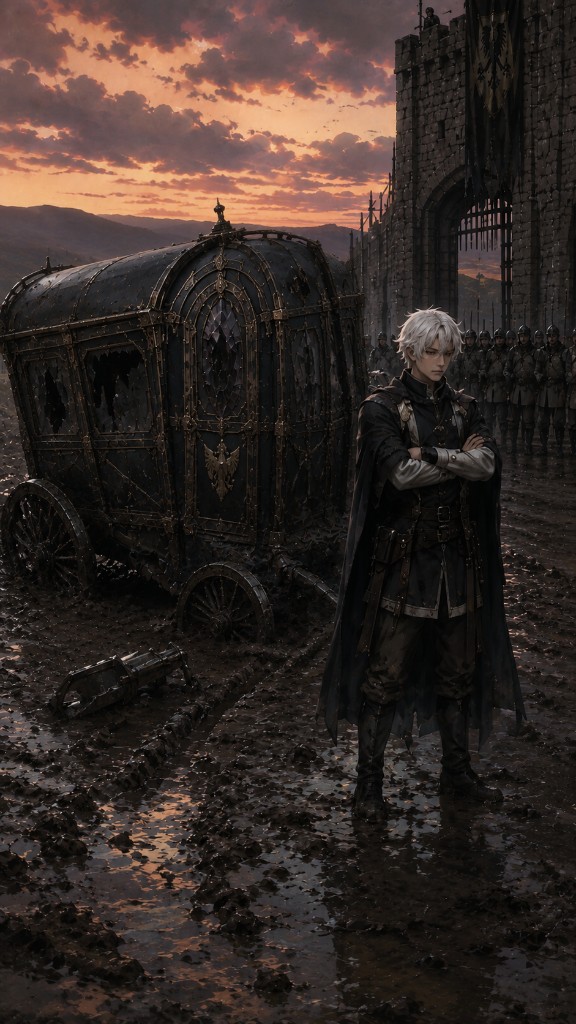
I yawned so hard my jaw cracked.
The road had a rhythm to it, a long sway that had spent two weeks trying to put me to sleep. Fourteen days of forest and mud and mountain passes.
It should have been faster.
But the Empire's roads kept feeding us work.
Goblins on the third day, a whole nest of them pouring out of a collapsed overpass, shrieking and hurling sharpened femurs down at the cars. One of the bone spears punched through the canvas side panel a hand's width from a Knight's knee and cracked a coil housing when it hit the floor. We'd lost half a day while Dorn soldered the housing back together by mana-glow in the dark.
The serpent in the river on the sixth day. Eight meters of muscle that had decided we were its next prey. It took Henrik's greatsword, two Knights, and a very cold hour before we could pull the cars through the shallows past its carcass.
And the wolves. The three-headed ones. Six of them, each head watching a different direction, so there was no such thing as flanking them. That fight had cost us a wheel bearing and a shattered side panel.
Every breakdown meant stopping. Every stop meant tools, wire, and prayer.
The cars were still rolling. Just barely. One door was tied shut with wire. The glyph channels beneath the floor had gone cloudy with grime and burnt insulation. The whole vehicle stank of hot copper and scorched crystal.
This was the most complicated part of the entire plan.
The roads.
If I couldn't make the roads safe, none of it mattered. Kaltbach could build anything we designed, and it would sit in warehouses while ox carts died on rut tracks and goblins pulled drivers out of their seats. The Empire's logistics would stay the same shit it had been for centuries.
I dragged a hand down my face. Stubble rasped under my fingers, thin white hairs along my jaw.
The forest opened ahead of us into cleared ground, and the walls of Grenzheim rose out of the plain, and against my chest, the pocket watch began to vibrate.
I fished it out and thumbed the crown. The translucent display bloomed over the steering assembly in pale blue letters, backlogged and impatient.
I stared at the numbers.
Two weeks of fighting and the tally came to one level here, two there. When I had first picked up a sword, every level had changed something I could feel. Straighter cuts, faster reads. Even a few months ago, I could have named what a new level bought me.
The numbers climbed. I stayed the same. The increments had shrunk from strides to steps, and lately from steps to something I had to take the grimoire's word for.
Stuck. That was the word for it, even if the numbers argued otherwise.
I closed the display.
"Gate's manned," Henrik said. "They've seen us."
"Slow down."
"No. I can't."
The magi-car gave one last shudder beneath the floor. The hum died. The glyph channels went dark. We coasted the last hundred meters on momentum alone, silent as a cart, and rolled to a stop almost in front of the north gate.
Henrik sat back and let go of the steering bar.
"Who would have thought," he said. "We made it." He looked like a man who had won a bet against God. "I thought the magi-cars would die long before this."
"So did I."
Behind us, the second magi-car had more trouble stopping. I heard Dorn kill the drive, heard the shout go up, and turned to watch six Knights bail out of the moving vehicle and physically catch it. Boots skidding in the mud of the gate road, shoulders against the panels to a halt before it could introduce itself to the ditch.
A gate soldier leapt aside trying to avoid being runover.
The brakes had finished dying somewhere in the last meters.
The gate guards were staring. Word moves fast in a garrison town, and white hair travels faster than news. One of them disappeared through the gate at a run.
We started unloading. Crates came down off the racks. The Knights worked in pairs, stacking everything in a neat line off the road while the last light died over the walls.
That was when the soldiers came out.
A dozen of them in garrison gray, and at their front, three people in town clothing. A clerk hugging a ledger. An older councilman with a fur collar. And between them, walking slightly ahead, a woman I knew.
I'd sat across from her at that desk a dozen times. She'd bullied an Academy relay into dispatching a linguist for me once. Small woman. Ink-stained fingers. The kind of tired face that belongs to the only person in any office who actually knows where everything is.
Mira.
She stopped near the dead magi-car, then she looked at me.
"Do they have any chance of running again," she asked, "or do you want the soldiers to drag them off my road?"
"God only knows." I nodded at the crates. "We'll want the parts regardless. Whether any of it's still usable, I genuinely couldn't say." I tipped my head toward the Knights. "But leave that to them. They've grown attached."
"So I see. They're holding the second one like a widow at a funeral."
"They caught it. That's attachment."
Something that was almost a smile crossed her face and then got put away. She looked me over. White stubble, road filth, the sword.
"It's been a long time," I said. "How are things at the secretariat?"
"I'm not there anymore."
"No?"
"I was doing ninety percent of the work as it was." She said it without bitterness. "After the mobilization, the assault, and the mess after, the town held elections. I put my name in." She lifted one shoulder. "I won."
"Mayor."
"Mayor."
"Then we're going to be working together." I put my hand out. "It'll be a pleasure."
She took it. Her grip was stronger than her fingers looked.
The soldiers had formed a loose ring at a respectful distance, pretending to be busy. The clerk with the ledger was writing something that was absolutely not about us.
We walked. Toward the town hall and the central square, up the graded streets, past the closing stalls of the evening market.
"Grenzheim has never had a lord," Mira said as we walked. "The Crown built the garrison, the town elected its mayor, and we stayed that way for a hundred and fifty years." She glanced sideways at me. "Then a rider came through with the news that the town had been granted to a Baron. You can imagine how that went over in the square."
"I can."
"There were arguments. Half the council said a lord meant the end of our charter. The other half said it didn't matter what we thought, because it was an order by the Crown." She stopped at the edge of the square and turned to face me. "So I'm going to ask directly, because I'd rather be rude tonight than sorry for a decade. What do you intend to do with us?"
"I don't intend to change a single thing about how you run this town," I said. "You were elected. The charter stands."
"And what does the Baron demand, in exchange for that generosity?"
"That the town is safe and prospering. That's the whole of it."
She studied me for a moment.
Behind her, across the square, lamplight was coming on in the windows of a tavern with a crooked doorframe. Somewhere in there, a girl who used to carry impossible stacks of plates was probably carrying slightly larger ones by now.
Mira started walking again.
"Tell me the plans," she said. "I know why they put you here. I'm not naive. I read the same papers everyone else does, and I know a political move when it lands on my doorstep. But I need to know whether there's anything in those plans for this town. Or whether we're a name on a document and a flag on a wall."
"Fair." I matched her pace. "Kaltbach was in my original plans. I will expand it to become an industrial city. Manufacturing on a scale the capital can't support anymore. That part was planned before Grenzheim was ever attached to my name."
"And now that it has been?"
"Now Grenzheim is a step beyond." I gestured south, toward the darkening horizon and the front that sat a day's march away. "Kaltbach builds. Grenzheim tests. Weapons and equipment off the northern lines get proven here, within a day of the soldiers who'll actually use it. What works goes straight to the front line."
Mira was quiet.
"You'll need better roads," she said finally.
"And better freight. And relay crystals on every stretch between here and Kaltbach." I glanced at her. "You spent hours telling me the Empire forgets anything south of the last tollhouse unless it's actively on fire. Congratulations. Your complaints are my worries now."
That got the smile all the way out.
"I have plans for the forges too," I went on. "This town has smiths the capital should be jealous of. Glyph work, military fittings, crystal housings. I'm going to send people here. Apprentices. They'll learn under your smiths. They'll be very well paid, and when they're ready they'll carry that craft north and teach it to a hundred more."
"Grenzheim will sell its knowledge to northerners?"
"In exchange Grenzheim gets standing, coin, and the best-equipped garrison district in the Empire. Yes."
"That's it?" she asked.
I looked at her.
"There are plans I can't discuss yet," I said. "You'll know before the town needs to brace for them. You have my word on that. But not tonight."
Mira considered it.
"I understand," she said. "Don't make me regret understanding."
"I'll try not to."
"Give me three days." She stopped again, at the foot of the town hall steps. "I'll write you a report. Every problem this town has. You want to govern us? Fine. But you're going to know exactly where you're standing."
"I was going to ask for exactly that."
"Then you're smarter than my predecessors," Mira said.
She went up the steps. The clerk and the councilman hurried after her, the ledger already open.
I went to find my Knights.
The Iron Cross rest house sat in the upper district. An old stone building with thick walls and a walled yard, requisitioned years ago and never given back. From the yard you could see over the barracks ring and the farmland beyond, all the way south to where the land went dark.
When I came through the door, steel covered every horizontal surface. Swords oiled. Coils rewound. Armor straps replaced. Henrik sat on the floor with his greatsword across his knees, running a whetstone down the blade in long, even strokes. Dorn was rechecking the crystal housing we'd soldered fourteen days ago, out of pure suspicion.
I let the door bang shut behind me.
Faces came up. Ten of them. Road-filthy, road-tired.
I walked to the center of the room.
"Tomorrow the work starts," I said.
"It's time to put fear in the hearts of the elves."