I don't remember the sun anymore.
It's been a long time.
When we came down here, I think I was nine. Maybe ten. Everything happened fast. Dad was shouting. Mom was carrying my sister. The elevator doors closed and the numbers on the panel went down and down and down until there were no more numbers.
Dad said it was the Keth'aa.
He said a ship appeared above our city. Something that hung in the sky without moving, without sound.
Then it fired.
A beam of light came down from the center of the thing and hit the ground and our city stopped existing.
Dad said that's what the Keth'aa do.
Dad said the Keth'aa could see electricity. Lights, radios, cables. Anything switched on told them where we were.
That's why we went underground.
I didn't understand most of it at the time.
I just knew the sun was above us and then it wasn't.
The walls and floors are concrete. The ceiling is concrete with metal beams running through it and lights bolted to the beams that hum all day and all night.
The air smells like metal and something chemical that Mrs. Patterson says is the filtration system.
Dad works on the fourth floor. He wears his uniform every day even though there's nowhere to go. He says routine matters. He says discipline is what separates the living from the dead.
Mom doesn't wear her uniform anymore. She stays in our quarters on the third floor and reads.
We have tablets, military-issue devices loaded with the archive before the facility sealed. Every book ever digitized. Novels, manuals, histories, poetry, children's stories, scientific journals. Thousands of titles saved on thin glass screens that glow faintly in the dark.
Mom cycles through them one after another, sometimes three or four in a day, curled on the cot with the tablet propped against her knees.
My sister cries at night. She says the walls are too close. She says she can't breathe even though the air comes through the vents just fine.
There are sixty-one people in the facility.
Eleven are children. Twenty-three are military. The rest are researchers or family.
We eat in the mess on the second floor at 0700 and 1800. The food comes from sealed containers that were stacked in the supply room before we arrived. Mrs. Patterson says the containers will last years if we ration carefully.
The lower sublevels help. Between the twentieth and thirtieth floors, teams have built hydroponic bays beneath grow-lights powered by the reactor. Trays of lettuce, beans, root vegetables. A few chickens on sublevel twenty-two. Two goats on twenty-four.
It's more food than the sealed containers alone could provide.
Sometimes I look at the trays and try to count how many meals are growing. I always lose track.
Mrs. Patterson says we will be all right as long as the lights stay on, the water keeps running, and the chickens don't get sick.
Three years later.
I was approved as a junior researcher today.
Dr. Vasquez signed the authorization himself. He said I was good at numbers. He said they need everyone who can help, even kids.
I'm twelve.
The work is on the ninth floor. At first, I only copy instrument readings, clean the crystal plates, and check calculations against the archive. They don't let me touch a live array yet.
Dr. Chen says mana is everywhere, even if I can't feel it. The older researchers are building machines that can use it outside the human body.
We can still talk with the other bases. We connect to the east through a hardline that runs beneath the mountains and most of the others through a satellite relay that Dr. Chen's team maintains. The relay is degrading. Nobody knows how much longer it will hold.
People say Asia is gone. Orcs and Mind Eaters. I asked what gone meant. Nobody answered.
I heard Dr. Vasquez say the governments let the Mind Eaters in because they promised eternal bliss. Then they took people's minds.
I don't understand why anyone believed them.
North Africa is still standing. Titans haven't migrated south of the Mediterranean basin. Nobody knows how long that holds.
My parents seem nervous.
They whisper at night when they think I'm asleep.
I try to stay focused on the work.
On the tenth floor, there's a girl. She's close to my age. A year younger, maybe. Her father is the Colonel. She doesn't talk much.
There's nowhere to take her. But we made plans to spend time together. Maybe the recreation floor.
We can make it work.
Five years later.
Her name is Ana.
She doesn't like being called by her rank. She enlisted at fifteen because the facility requires everyone over fourteen to serve in some capacity, and she chose technical operations over kitchen rotation. Her father objected. She told him she could follow orders or she could give them, and either way she was going to be useful.
She won that argument.
We play chess every third evening. She's better than me.
I've beaten her twice.
Both times she was distracted by something her father had said.
The research is advancing. We've confirmed that mana can be converted to electrical potential. The output is barely enough to power a lighting array and nowhere near enough to sustain the facility or charge a reactor, but the principle is sound.
Dr. Vasquez says the next step is kinetic conversion. If mana can become electricity, it can become motion. If it can become motion, it can become force.
If it can become force, we can build weapons that don't require gunpowder, steel barrels, or anything the Durak-Kel have claimed.
I told Ana about it.
She asked me if I thought it would matter.
I said yes.
She looked at me over the board.
"I hope you're right," she said.
Ten years later.
We had our first child.
A boy.
He has Ana's eyes and my hands. He cries when the ventilation system cycles to its low-frequency mode, which happens every four hours, which means he cries six times a day.
Ana says he'll get used to it.
I'm not sure anyone gets used to it.
He's our first and I don't know if we'll have another.
The resources are scarce. Every calorie is accounted for. Every liter of water is recycled, filtered, recycled again. The air comes through the same filtration system that Mrs. Patterson explained to me when I was nine years old. The filters are older now. The air tastes different.
There was a surface pipe, a narrow ventilation shaft that ran from the ninth floor to the surface. It was supposed to supplement the internal filtration system with outside air.
It broke three years ago.
A collapse on the surface, maybe. Or something living decided the pipe was interesting. The sensors showed a blockage at approximately forty meters.
I volunteered to go up and repair it.
They said no.
I volunteered again. I drafted a repair plan. I showed them the schematics, the likely blockage, the tools, the hours.
Still no. Not the mission.
The mission is the research.
At least the mission is progressing. We've achieved directed mana discharge.
The focusing chamber turns mana into force and throws it across the room. No combustion. No electricity. No projectile.
The prototype is crude. It sits on a reinforced table on the ninth floor and looks like a pipe attached to a box.
But it fires.
Two years later.
I don't know what happened.
A bombardment. A Titan. Something from above.
The ground shook for nine seconds. Then the floor cracked.
The fifth sublevel collapsed. Everything beneath it went with it.
The stairs are gone. The elevator shaft is filled with rubble. The lower access corridors are sealed. Crushed concrete, twisted steel, darkness where there used to be rooms and people.
The labs, the workshops, and the crystal arrays were gone. The Mark III went with them.
Only the first four sublevels remain.
The communications array was on sublevel six. We can't reach Base 44. We can't reach anyone.
We are alone.
The food lasted four days.
The water recycler failed on the second day. Ana tried to repair it with the tools we had. She worked for eleven hours before she admitted it couldn't be done. Not without parts from the lower levels.
The air is thinning. The internal filtration is still cycling but the output has dropped. Each breath requires a fraction more effort than the last.
We could go to the surface.
Ana said we don't know what's up there. She said the Keth'aa might still be scanning. She said opening the surface hatch could expose the facility's position and endanger whatever remains of the network.
She's right.
But the network is gone. The satellites are silent. We are the only ones left, and we are dying three floors beneath a surface we cannot see.
There are pills.
Small white capsules in a sealed container. Enough for a painless end.
Not enough for everyone.
One for Ana. One for our son.
There wasn't one left for me.
I told her it was fine.
I have my father's old service pistol. He said every officer should carry one, even underground.
It will be quick.
I'm writing this because someone might find it.
Maybe not for a very long time.
But someone will come down eventually, open the door, and find these rooms, the people in them, and the work we left behind.
If you found this, I have faith in you.
I believe you will finish what we started. The world above is still worth it, even if I never see it again.
God our Father, protect humanity.
Give us the strength to endure.
And let them have the light we could not reach
The sentence ended there.
The last stroke of ink trailed from the final word into a thin descending line, as though the pen had simply slipped from the hand.
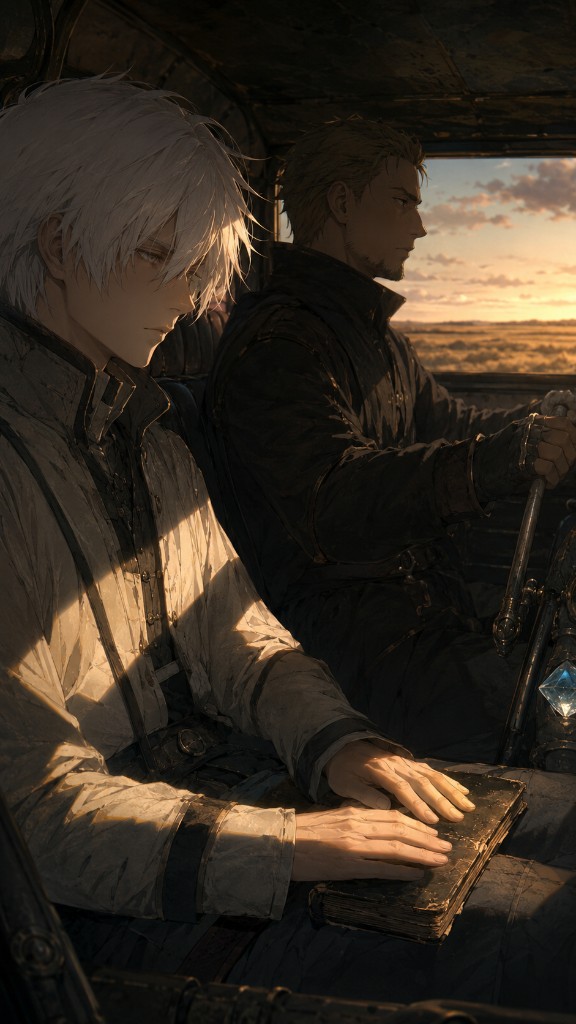
I closed the book.
The oilcloth binding crackled against my fingers. The pages were brittle. The leather cover had dried and split along the spine.
The magi-car swayed beneath me. Henrik drove in silence, both hands on the steering bar, his eyes on the road ahead.
I held the book in my lap and said nothing.
I pressed the oilcloth cover flat against my knee and stared at the stitching along the spine.
The hours passed. I did not open the book again.
Late in the afternoon, the road crested a final rise and the land dropped away to the south. The horizon broadened.
Henrik leaned forward over the steering bar.
"Grenzheim," he said.