We left before the sun cleared the eastern wall.
Four magi-cars in a tight column. Two freight wagons behind them. The other magi-cars stayed in the garrison yard. Dorn had cannibalized most of their pieces overnight to have enough for any situation that might happen.
The north gate was still shut when we passed through the eastern service exit. A supply door, wide enough for a single cart, manned by two garrison soldiers.
One of them started to speak.
Henrik didn't slow down.
The magi-car slipped through the gap, and the second followed, and the third, and the fourth, and the two freight wagons rumbled after them before the soldier had finished opening his mouth.
I looked back. The soldier stood in the road with his hand half-raised, staring at the column disappearing south.
"Think he'll report it?" Henrik asked.
"He'll mention it. By then we'll be at the front."
The land south of the road had been cleared deliberately. Trees had been cut back until nothing taller than knee-high scrub remained within hundreds of meters of the southern road. The open ground gave the watchtowers and bunker observers an unobstructed view of anyone moving north from the front.
I knew the road well enough to travel it with my eyes closed.
That did not make it easy.
The surface changed every few hundred meters. Sections of old-world concrete emerged from the earth in fractured gray slabs, only to vanish beneath hard-packed dirt ground flat by generations of supply carriages traveling to and from the front line.
Henrik's eyes swept the horizon.
"Quiet," he said.
"For now."
I'd been counting. No bombardment flashes on the southern horizon. The elves maintained a four-barrage-per-day rotation, and the first usually landed in the early morning hours.
Either we'd arrived in a gap between rotations, or the rotation had shifted.
Neither possibility was comforting.
The road descended into the network of lateral tracks that connected the forward bunker installations.
"The western sector," I said.
Henrik glanced at me.
"You've served here."
"Months ago. Right after I joined the Iron Cross."
The bunker appeared as we rounded a low hill — a squat concrete structure half-buried in the slope, its entrance concealed behind blast walls and a zigzag approach designed to stop a direct spell from reaching it.
Soldiers appeared at the blast walls as we approached.
Henrik stopped the lead magi-car.
I stepped out.
The bunker's entrance disgorged a small group.
Commander Wendt walked at its head.
Behind him: three officers and a communications technician carrying a portable crystal array.
Wendt stopped four paces from me. His gaze moved across my face, my hair, the sword at my hip. Then it passed to the column behind me.
"Lord Kaspar," he said.
The title sat oddly on his tongue. The last time I'd stood in front of this man, I'd been a newbie.
"Commander."
His mouth compressed into its permanent line.
"It is good to have you back." His eyes moved to the freight wagons. "I hope you have not brought me another attack."
"No. Quite the opposite."
Wendt's brow shifted.
"You will need to explain that," he said.
"I will. Inside."
Wendt turned without another word. His officers fell in behind him. I followed, gesturing for Henrik and Dorn to join me.
We descended through two levels of corridors before reaching one of the command rooms.
A half-dozen officers and communications operators occupied the room. They looked up as we entered.
Wendt pulled a chair from the central table and sat down without ceremony.
"Explain," he said.
I reached inside my coat and produced the sealed letters. I broke the seal, removed Varen's mission order, and placed it on the table in front of Wendt.
He picked it up.
His expression didn't change.
But his officers noticed his seriousness.
Wendt set the paper down.
"This is the prince's signature and the Iron Cross command seal"
"Correct, sir."
"And you are here because this" — he tapped the document — "orders me to place my installation under your operational authority for the duration of the mission described herein."
"That's right."
Wendt looked at me for a long time.
He's deciding whether to trust this or not.
Whatever he thought of the order the seal was genuine and the signature was real and Commander Wendt was the kind of man who trusted the chain of command.
"What do you need?" he asked.
"First: communications silence. I need you to shut down every external comm crystal in this installation," I said. "Every link to other bunkers, to Grenzheim, to the Regular Army network. Everything goes dark."
Wendt's jaw worked.
"You are asking me to isolate my movements and let all be in the dark."
"I'm asking you to ensure that no information about what happens here in the next six hours reaches anyone outside these walls."
He leaned back.
"I know every man and woman in this bunker," Wendt said. "I have served with most of them for years. I trust them."
"I believe you."
"Then you should know that your request implies otherwise."
"It doesn't." I held his gaze. "It implies that there are people outside your bunker, in other sectors, in other installations, in the capital, who cannot be trusted. One routine status update, one supply request, one sentence overheard and that's all it takes."
Wendt's fingers drummed once on the table.
"We had a compromised asset in the Iron Cross itself," I continued. "A senior Knight. She turned on us and killed nineteen prisoners to destroy evidence."
Henrik shifted behind me.
"This mission cannot survive a leak," I said. "If the elves learn what we're planning before we execute."
Wendt looked at the comm crystals along the eastern wall.
Then he stood.
"Lieutenant."
The officer near the comm bank straightened.
"Shut them down."
"Sir?"
"Every crystal. Pull the cores from the housings and lock them in the signals safe."
The lieutenant hesitated for half a second.
"Now," Wendt said.
The man moved. Two technicians joined him. One by one, the blue glow of active crystals went dark along the eastern wall.
Wendt turned back to me.
"Done. What else?"
"My people need the staging area. We have equipment to unload and modifications to make."
Wendt gestured toward his officers.
"Thom."
A man stepped forward from behind the lieutenant's station. He was thinner than I remembered. His right forearm had been replaced with a Magitek prosthetic of dark iron and brass. Articulated plates formed the fingers, and compact gearwork shifted beneath the wrist housing when he moved. A reinforced leather sleeve joined the mechanism to his arm below the elbow.
The last time I'd seen him, he'd been bleeding against a corridor wall with his forearm gone.
Our eyes met.
Thom crossed the space between us before Wendt could continue and extended his mechanical hand.
"Kaspar," he said. Warmth broke through the weariness in his face. "Damn good to see you alive."
I took his hand.
"Good to see you too, Thom."
His gaze moved over the breadth of my shoulders and the white hair falling around my face.
"You've changed."
"So have you."
Thom glanced down at the metal forearm.
"Army physicians said I was lucky."
"You were."
Thom squeezed my hand once and released it.
"Show Lord Kaspar's people to the staging area," Wendt continued. "Clear whatever they need cleared."
"Yes, Commander."
I leaned toward Wendt before leaving.
"One more thing. A carriage should arrive within the hour. We'll need that passenger."
The staging area was a long, open chamber behind the bunker. The ceiling was high enough for the freight wagons. The floor was bare concrete and cracked in places.
The Knights unloaded the crates. Equipment came off the wagons in order. Copper sheeting first — flat panels, each one a meter wide and two meters long, their edges rough-cut. Then the tools: hammers, shears, bending jigs, welding rods.
The four functional magi-cars were driven into the bay and lined up side by side.
I walked the line.
The cars were standard production. Wooden bodies. Crystal drive housings beneath the floor. Canvas side panels. Open rear compartments.
"Listen up," I said.
The Knights gathered.
"We need to modify these vehicles." I placed one hand on the nearest car's front panel. "The copper sheeting gets attached to the front and both sides. Not flat — angled. A prow. Shaped like this."
I held my hands apart, fingertips touching, forming a V.
"The point faces forward. The angle deflects blast energy outward instead of absorbing it head-on."
Dorn crouched beside the nearest car and examined the frame.
"We can do it," he said. He ran two fingers along the wooden chassis where the front panel met the axle housing. "But these frames weren't designed to carry armor. We reinforce the joints, angle the plates, and distribute the weight across the front assembly, they'll survive one direct strike. Probably two."
"And after that?" Henrik asked.
"After the second serious hit, the attachments start tearing themselves out of the frame. The copper may hold. The car won't."
"Two hits are enough," I said.
Dorn looked up at me.
"Only if they don't stop."
"They won't." I tapped the crystal drive housing beneath the floor. "Whoever drives takes the vehicle forward at the highest speed the frame can survive. Burn the entire crystal if necessary. I don't care if it becomes dead glass the moment the car reaches the other side. These vehicles only need to make one trip."
Dorn held my gaze for a moment, then nodded.
"Then we can do it."
Britta ran her hand along the panel.
"Four cars," she said. "How many people per car?"
Britta was one of the youngest Knights in the room. Her technical instincts were sharp, but her field record was short. She came from three generations of Regular Army soldiers. Her father had died on the southern front, her mother still worked in Grenzheim's military laundry, and both of her older brothers served in garrison units. Combined with the investigation Augustin had ordered into every member of the team, that history made her one of the least likely infiltrators among us.
However Britta's inexperience demanded attention for a different reason. I would need to keep her close enough to correct mistakes before the battlefield made them permanent.
"One," I said. "The driver."
Henrik looked toward the open rear compartment.
"The rest of us go on foot?"
"Beside them or behind them. The copper prow is moving cover. Two Knights stay tight against each side panel, close enough that the armor takes the first spell. The others run directly behind the cars and use the entire vehicle as a shield."
Henrik looked at the width of the prow I had outlined.
"And when the cars die?" Henrik asked.
"We leave them where they stop and continue on foot."
I clapped my hands together. The sound echoed off the concrete ceiling.
"Let's start!"
The work took the next three hours.
The staging area filled with the sound of hammers striking copper, shears cutting metal, and Knights cursing the inadequacy of civilian vehicle frames under military application.
Dorn led the structural work. He had an engineer's eye. He measured twice, drilled once, and the joints he produced were cleaner than most of the capital's factories put out.
Henrik handled the heavy lifting. He held panels in position with one hand while another Knight locked the seams.
I moved between stations, checking fits, testing angles, helping where another pair of hands was needed.
The first car was finished by midmorning. The copper prow jutted from its front like the bow of a ship. The side panels had been reinforced with additional copper layered over the wood.
Henrik climbed into the driver's seat and tested the steering bar.
"Heavy," he said. "The added weight pulls the front axle down. Steering response is sluggish."
"Can you compensate?"
He turned the bar left and right, feeling the resistance.
"With Mana Blood, yes. Without it, barely."
Three more cars to go.
I was helping Britta hammer a side panel into place when the sound came from outside.
Horse hooves on packed earth. A single vehicle.
I set down the hammer and walked to the staging area's entrance.
A carriage sat in the access road. Black wood. No markings. No insignia.
A figure stepped down from the passenger compartment.
He wore Academy robes. Dark fabric, cut close, the hem muddied from travel. Raven-black hair fell past his shoulders.
Long, pointed ears extended past the crown of his head.
Olive-brown skin.
Lean build.
Professor Molino.
I had seen this man dozens of times during my loops on Grenzheim.
"Professor Molino."
He turned. His eyes moved across my face. Recognition came.
"Mr. Hexenzeit," he said.
His voice was exactly as I remembered.
"It's been a long time, Professor."
"It has."
He did not elaborate.
Still the same. Efficient to the bone.
I gestured toward the bunker.
"Thank you for coming. I know this isn't where you expected to be."
"Prince Varen's request was specific. I am here because the mission requires capabilities I possess."
"It does."
I hesitated.
"Professor, I need to ask you something, and I understand if it's unwelcome."
Molino's expression did not change.
"This mission involves crossing the elven line," I said. "Engaging elven positions directly. Killing elves, if it comes to that."
I looked at his ears. At the features that marked him as what he was.
"I need to know that you're prepared for that. Given that there is elven blood in you."
Molino looked at me for a long time.
"Do you know," he said quietly, "how half-elves are born?"
I shook my head.
"No."
Molino turned away from me. He looked south.
"Humans cannot impregnate elves," he said. "The biology does not work in that direction. The compatibility is one-way. An elf can father a child with a human woman. A human man cannot father a child with an elven woman."
His voice remained flat. As though he were delivering a lecture on botanical reproduction.
"The elves do not regard humans as beings of equivalent status. They never have. We are vermin to them. Animals, at best." He paused. "But animals can be used for entertainment."
My stomach tightened.
"Every half-elf alive today exists because an elven male chose to use a human woman for his amusement." Molino's hands remained at his sides.
The staging area was silent.
"Half-elves are not a bridge between two peoples," Molino continued. "We are evidence. A reminder of what they do to us."
He turned back to me.
"You asked whether I am prepared to fight them."
His dark eyes held mine.
"I have been fighting them since the day I was born."
I held his gaze.
"I'm sorry, Professor. I shouldn't have asked."
"You should have." His tone softened by a degree. "A commander who does not question his people's loyalties before a battle is a commander who puts everyone at risk."
He reached into his robes and produced a sealed envelope.
"Prince Varen instructed me to deliver this personally."
I broke the seal.
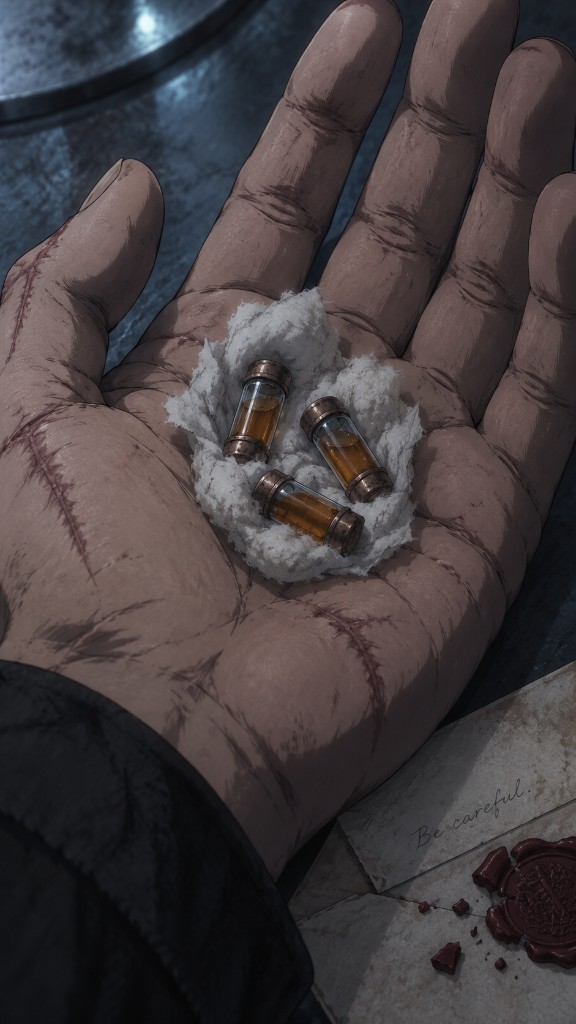
Inside: a single folded sheet of paper. And wrapped within the paper, nestled in cotton wadding, three small capsules.
I unfolded the paper.
The handwriting was cramped and hurried.
I did what you asked. It is weaker than the original. Each one lasts approximately four minutes.
Be careful.
— H.
Hayyan.
I stared at the three capsules in my palm.
I folded the paper, slipped the capsules into the inner pocket of my coat, and buttoned it shut.
"Thank you, Professor."
"Prince Varen also sent those copper shells with me."
"How much?"
"I don't know. You'll have to check." He glanced back at the black carriage. "He has also arranged for supplies to arrive each day."
"I'll have it unloaded with the wagons."
He inclined his head.
"Where do you need me?"
"Inside. I'll brief the full team in one hour."
The command room felt smaller with all of us in it.
Eleven Knights. Wendt and four of his officers. Thom, standing near the door with his mechanical hand resting on his belt. Molino, seated at the far end of the table with his robes folded neatly around him.
I spread the installation map across the table.
The bunker sat at the center. South of it, the human trench network cut across the page in thick black lines. Beyond that lay no-man's-land, the mine fields, the spell batteries, and the elven positions.
I placed one finger on the ground directly south of the bunker.
Then I drew it forward through the defensive grid, tracing a narrow corridor toward the elven line.
Every face in the room followed the movement.
I stopped at the final row of human defenses and looked at Molino.
"Professor," I said, "can you disable every mine, ward, and defensive formation along this corridor?"