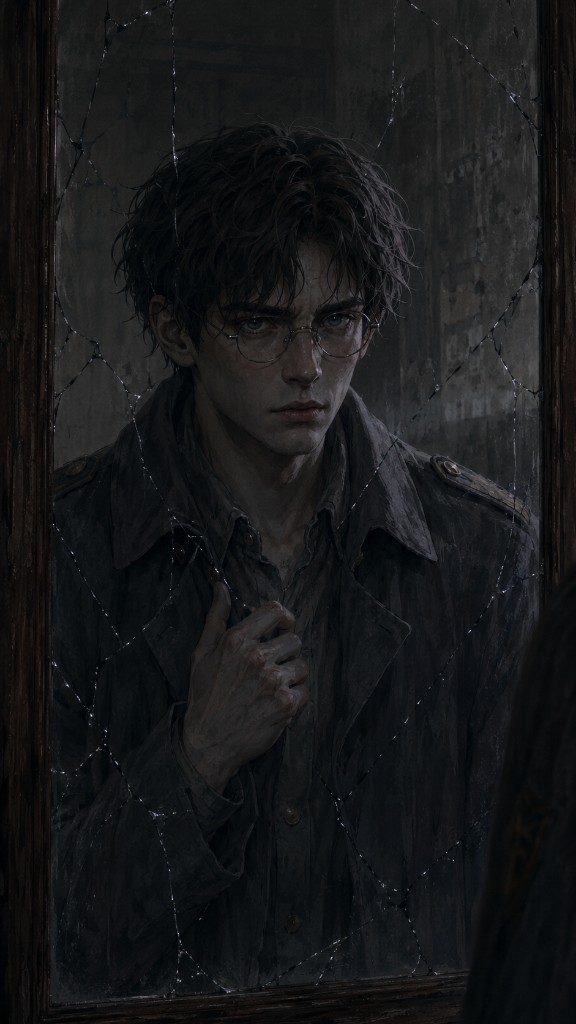
North of Hexenzeit, on the Wolkenmark border.
Kaltbach lay beyond the last proper road.
Emil had crossed through Hexenzeit territory, keeping to the northern trade routes until the paved stretches became packed dirt, then rutted mud, then little more than wagon scars. The land changed as he traveled. The rolling farm country south of the border gave way to long gray valleys, thorny scrub forests.
The last Hexenzeit banner had been two days south. A faded crimson flame on a cracked post at the edge of a barley field. After that, the road ran past roofs with no crest and no manor behind them.
By the seventh morning, a wet snow had begun to fall. Just enough to turn every roof black with meltwater and every breath into a pale cloud.
Emil climbed the last low hill on foot, his travel pack biting into his shoulders, and saw Kaltbach spread across the valley below.
Three hundred structures clustered around a central square: workshops, grain sheds, a timber market, farmland stretching toward the dark line of the northern forests. Large, by frontier standards.
It had grown that way because no one had stopped it, and no one had claimed it. The land sat on the Wolkenmark corridor, too close to the Republic for glory and too full of settlers and mutants for any house to want the title. A surveyor would have ridden past and left the page blank.
The reason was visible from the hill.
Some were ordinary farmers and laborers in patched wool coats, their faces red from the cold, their hands cracked and dirt-stained. But among them walked a man with a heavy ridge of black horn curling from one temple. A woman with pale gray scales across her throat and cheeks carried a basket of turnips beneath one arm. Two children chased each other through the mud outside a house, one with a tail tucked beneath his coat, the other with dark feathers sprouting along the sides of his neck.
Near the central square, something burned.
A wooden effigy had been raised above the old well. It wore a crude Imperial officer's coat stuffed with straw. A painted wooden crown sat on its head.
The flames had already eaten through its chest.
A crowd stood around it.
Even at this distance, Emil could hear them.
"Food before tribute!"
"Where are the patrols when the boars come?"
"Three sons from one house! Three!"
"Blood for the southern front, copper for the Crown!"
The words rolled upward through the gray morning.
Beyond the crowd, a line of Regular Army soldiers held the square's eastern street. They wore gray coats over leather that did not match. Some coats hung past the knee. Some helmets sat loose. Wands hung from belts or rested against shoulders. These were not Circle-bearers. They were what the southern front had left behind.
They looked frightened.
There were perhaps thirty of them, scattered in a loose cordon between the square and the town hall. An old sergeant stood near the left end, gray in his beard, a stave with a dull chip of crystal at the tip. Beside him a boy who could not have been older than Emil held his wand in both hands. The crystal in it was the size of a pea, cloudy, cheap.
Their officer stood near the front, shouting through a brass amplification cone. His voice had the tight pitch of a man counting heads and finding himself short.
"Disperse! Return to your homes! The collector has been delayed by the weather! Petitions will be heard when he arrives!"
The answer came back as a roar.
"WE SENT PETITIONS LAST WINTER!"
"MY BROTHER DIED AT THE FRONT!"
"THEY TOOK OUR GRAIN!"
"THEY TOOK OUR CHILDREN!"
Emil stood on the hill and watched smoke rise.
The taxes had doubled. The north received almost nothing in exchange. There was no lord here to hear a petition. Only the collector, when he came. When iron-tusk boars descended from the forests and ripped through livestock pens, Kaltbach defended itself. When raiders crossed the northern border, Kaltbach defended itself. When recruiters came looking for bodies to throw at the southern front, they found young mutant men and women in numbers wildly disproportionate to the town's population.
The Empire took.
That was real. But so were the people in the crowd who had been sent there to make the anger boil.
Emil had been told there would be operatives among the townsfolk. People placed in advance. People who would shout the right words and make the right movements. The rest was his.
Emil adjusted the strap of his pack and began walking downhill.
The inn stood on the western edge of the square.
Its sign had once shown a black stag leaping over a river. Wind had worn most of the paint away. Now the animal looked like a smear of antlers and mud.
The common room was half full.
Three broad-shouldered laborers sat near the hearth with untouched cups of beer in front of them. A woman with pale yellow eyes and a wrapped left hand sat alone in the corner, watching the square through a gap in the shutters. An old man with thick fur covering the backs of both hands rolled a pair of dice across a table without looking at the result.
Everyone heard the crowd outside and pretended they did not.
Emil chose a table near the window. He sat with his back to the wall and ordered watered beer from the innkeeper, a short woman with one long ear and one rounded human ear.
She set the cup in front of him.
"Passing through?" she asked.
"Northbound," Emil said.
She looked at his coat, at his soft hands, at the satchel on his hip. "Scholar? We don't see many."
"Historian. I know this is a poor week for it."
Her mouth tightened.
She tipped her chin toward the square. "No lord here to stop it, either."
Then she walked away.
Emil wrapped both hands around the cup but did not drink.
Outside, the officer's voice rose again through the brass cone.
"Last warning! Return to your homes!"
The crowd answered with a stone.
It flew from somewhere near the rear of the square. Emil saw it strike the front rank of soldiers through the gap in the shutter. The rock bounced off a helmet with a sharp iron crack.
The soldier flinched and looked at the men on either side of him. Nobody raised a wand.
Not yet.
The door opened behind him.
Cold air rolled through the common room.
A young man entered wearing a coat too large for his narrow shoulders. His hair was brown and wet with melting snow. He did not look at Emil when he crossed the room.
He stopped at the table beside Emil's.
He set down a copy of The Academy Voice and continued to the bar.
Emil waited until the young man had ordered a drink.
He took the newspaper. The edition was three days old.
Nothing unusual. But that was their sign for his contact.
The young man at the bar did not look at him. Emil rose and stood beside him anyway.
"Do you have the uniform? The wand?" Emil asked quietly.
The man took a drink.
"The uniform is in the first room upstairs. Standard Regular Army enlisted coat." He scratched at his cheek. "There is a wand on the bed."
"What Circle is it?"
The young man glanced at him.
"Why?"
"The instructions were to fire into the crowd."
"You were told to create an incident."
"How strong is it?"
The man looked back toward the square.
The crowd shouted again. The sound made the windowpanes tremble.
"First Circle output," he said. "Maybe less. It will hurt someone. It will not level a house."
Emil exhaled.
The pressure behind his ribs eased.
"How will I know when to fire?" Emil asked.
"The soldiers will converge on the square when the officer orders the second dispersal command. The crowd will move forward. Someone will be chosen." The man's fingers tightened around his cup. "When that person crosses the chalk line in front of the town hall, you fire."
"Chosen by whom?"
The man did not answer.
Something cold moved through his stomach.
"The first room," the contact said. "Left side."
The room upstairs smelled of damp wood and old wool.
A gray Regular Army coat lay folded across the bed.
Beside it sat a leather belt, a pair of worn boots, a dull iron helmet, and a standard-issue casting wand.
Emil stood over the wand for several seconds.
The wand was a plain black length of treated hardwood, capped with brass at both ends. A mana crystal had been set into the grip.
The sticks the men in the square carried held cloudy chips, pea-sized, the kind that sputtered after a handful of weak bolts. This one sat clear in the brass, larger than a walnut. Someone had filed the setting smooth. A stamp had been there. Emil could feel the ghost of it under his thumb.
Academy lecture halls used Grade A stones for demonstrations. This was brighter than that.
He put it down.
The contact had said that he would cast a First Circle spell. Something simple, something that didn’t require such a powerful crystal. Emil should have questioned that, but in his anxiety, he simply gripped the wand and thought about how to use it.
Emil stripped out of his travel clothes and put on the uniform.
The coat hung loosely from his shoulders. He was narrow. Too narrow. But the armor was padded beneath the cloth, the helmet hid most of his face, and in a town full of frightened men wearing the same gray coats, he would not stand out for long.
He looked at himself in the cracked mirror above the washstand.
A young Regular Army soldier stared back.
His face had gone pale.
You are not attacking them, he told himself.
The recruiter's voice came back with perfect clarity.
You will make them see how the Empire consumes them.
The square had changed.
The burning effigy had collapsed.
Its head lay in the mud near the well, half charred, the painted crown melted.
Families who had hidden in their homes had emerged to watch. Some stood in doorways. Others gathered behind the first line of protesters. Mutants and baseline humans stood side by side.
A woman with leonine features held a baby beneath her coat.
An elderly man with long, bent fingers leaned on a wooden staff.
A boy of perhaps sixteen stood near the front with short horns emerging from his hairline. His jaw was clenched hard enough that the muscles stood out along his cheeks.
The soldiers were moving.
From the side streets, more gray-coated figures emerged in groups of four and five. They joined the loose line at the square's eastern edge. A thickening. Mismatched boots. A man with a limp. Wands of different lengths, different crystals, all of them cheap.
The officer raised his brass cone again.
"By order of the Imperial Crown," he shouted, "this assembly is unlawful! Disperse immediately!"
A chant began at the back of the crowd.
"Food before tribute."
Others joined.
"Food before tribute!"
"Food before tribute!"
The sound built.
Emil moved with the soldiers.
No one stopped him.
No one asked his name.
He took up a place in the third rank, near a broad man with a scar across his scalp and a younger soldier whose hands shook around his wand.
The scarred man smelled of sweat and old leather. He glanced at Emil once.
"New transfer?" he muttered.
Emil nodded.
"Stay behind the shields. If this turns, we die. You understand that? There's no way we can fight mutants. That's a town full of them out there."
Emil's mouth went dry.
The officer lifted one hand.
"Final warning!"
A few people at the edge of the square began to step back.
The woman with the baby turned toward the western street.
The old man lowered his head.
More followed. A gap opened near the well. The officer's shoulders dropped a fraction.
Then someone screamed from the rear of the crowd.
"They are going to take more children!"
The words cut through everything.
The woman with the baby stopped. The old man lifted his head. People who had been leaving turned back toward the square.
A man near the front threw a stone.
This one struck a soldier in the face.
Blood burst from beneath the helmet's edge.
The soldier raised his wand.
The officer shouted, "Hold!"
The soldier did not fire. His arm shook. The cheap crystal in his stick flickered and went dull.
The line held.
Someone in the crowd shoved.
The boy with the small horns stumbled forward. He could not have been older than sixteen. His coat was too thin for the weather. Mud stained his boots. His hands were empty. Still, he crossed the chalk line.
Emil saw it.
A faint white boundary drawn across the square's cobblestones.
The boy opened his mouth. Emil did not know whether it was a shout or a plea.
He lifted the wand.
He pushed mana into it. The crystal in the grip awakened. A magic circle formed at the tip of the wand. First Circle was a cough of light. So simple that, just by looking at it, you could tell what spell it was. This one was far too complex. This was a siege charge trying to leave through a stick.
The lances were already forming. Five rods of orange-white flame assembling above the square, too fast, too many.
No.
Emil jerked the wand. Away from the boy, away from the front of the crowd.
The lances went with the jerk. They scattered.
One punched through a woman two paces left of the boy. One took a man at the hip. One struck the cobblestones and bloomed. Two found the boy anyway, chest and throat, and the blast from the stones lifted what was left of him into the wall of the town hall.
Fire swallowed more than one body.
Bone fragments and burning cloth and red meat struck the cobblestones in every direction. A wet shape hit the pale stone and slid down, leaving a black-red smear. Beside it, the woman who had been standing left of the boy was no longer standing. The man at the hip had been thrown into the well's rim. Someone else was on fire and running, then not running.
The heat struck Emil's face.
He stood frozen with the wand still raised.
The crystal in the grip was a dead husk. A thing that had been worth more than this garrison's yearly pay, burned in a second.
The crowd went silent.
The mother with the baby screamed.
The sound tore through the square and changed everything.
The old man with the staff let it fall into the mud and raised empty hands, knuckles white.
The leonine woman shoved her child toward someone behind her and bared her teeth.
The boy's father ran into the fire. He dropped to his knees in the burning wreckage. He reached for what remained.
His eyes found the soldiers.
"MONSTERS!" the man screamed.
The square roared.
The first mutant hit the soldier line before the officer could give an order.
A broad man with tusks rising from his lower jaw crossed six meters in a single leap and landed on the scarred soldier beside Emil. The soldier's shield came up too late. The mutant's fist struck the iron rim, bent it inward, and drove the shield into the soldier's own face.
The soldier went down.
The next impact crushed his skull against the cobblestones.
The Regular Army line ruptured.
"CAST!" someone shouted.
"Hold formation!"
"THEY KILLED THEM!"
A wand in the second rank spat a late orange spark. It scuffed a man's coat and went out. Another soldier's crystal popped with a cheap sound, a puff of smoke, nothing else. A third managed a bolt no thicker than a finger. It hit the cobbles and died.
Someone tried wind. The air shoved. A protester staggered one step and kept coming.
A woman in the crowd still caught a spark on her sleeve. Her coat ignited. She stumbled three steps, shrieking, before a scaled man tackled her to the ground and tried to smother the fire with his own body.
A protester with black feathers along his arms hit another soldier from behind. His claws opened the man's neck.
Emil could not move. The wand hung from his hand, and blood steamed on the stones.
I tried to miss.
I killed them.
Someone collided with Emil's shoulder.
A soldier, running backward, whites showing beneath his helmet.
"Move!" the soldier shouted. "Move, you idiot!"
Emil didn't move.
People fought with fists, tools, knives, broken chair legs, sharpened farming hooks. Mutants surged into the soldiers with strength that turned armor into decoration.
Emil saw the father rise from beside his son.
His hands were empty. The coat burned at one sleeve and he did not seem to notice as he ran toward the gray uniforms.
The father never reached the line.
A bolt from somewhere in the soldier line scuffed the man's back, too weak to drop him. A second soldier, hands shaking, managed a thicker spark. It caught the burning sleeve and the man went down face-first onto the cobblestones. His body twitched once.
Emil looked down at his own wand.
The brass cap was dark. The crystal inside it had gone the color of burnt sugar, split down the middle.
The contact had lied.
A hand closed around Emil's shoulder. A young mutant had launched himself through the chaos.
He had pointed ears, a black canine nose, and tawny fur covering both forearms.
Emil raised the wand.
The mutant was already on him.
They hit the ground together.
The wand flew from Emil's hand and skidded across the blood-slick stones. His helmet tore free. The back of his head struck the cobblestones.
Pain flashed white through his vision.
The mutant straddled his chest.
His claws were long.
Emil grabbed at the mutant's wrists.
The strength behind them was impossible.
The claws descended.
"Wait," Emil gasped.
The mutant's face twisted.
"I didn't—"
The claws tore across his throat. The first strike opened skin, the second the artery, and when he tried to breathe, blood filled his mouth.
The sky above Kaltbach was gray. Snow drifted through the smoke.
Emil's hands fluttered once against the cobblestones.
Then they stopped.
His blood ran between the stones.