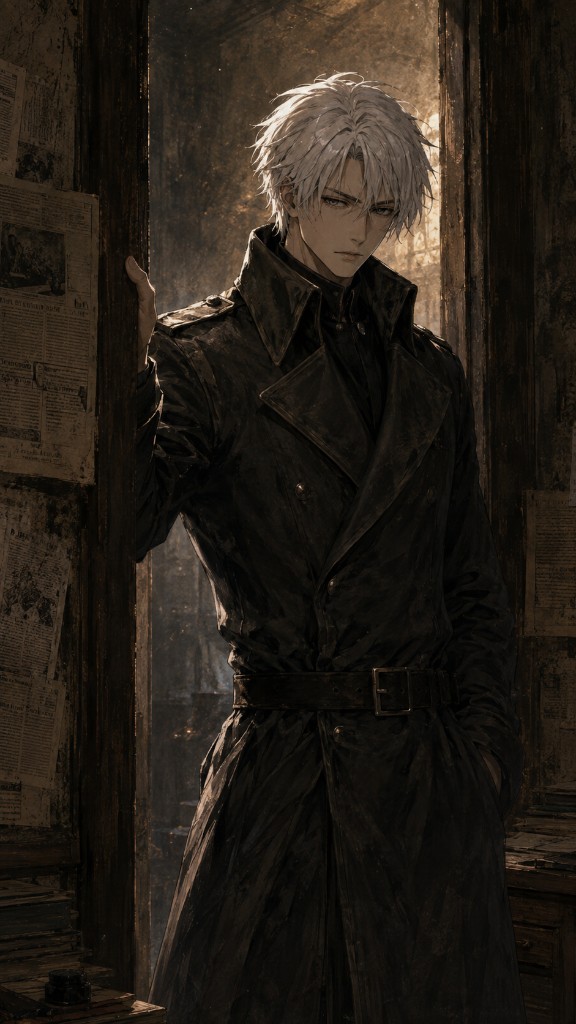
Augustin and I left the mill through the eastern gate while the queue outside continued to argue with itself.
The factory guards had begun separating the loudest nobles from the merely persistent ones. A servant in a blue-and-gold house livery tried to slip a sealed purse through the bars. One of the guards handed it back without opening it.
The road toward the Academy climbed gradually through the eastern quarter. The streets grew cleaner with every block. Warehouse fronts gave way to bookstores, student boarding houses, supply shops, and old concrete buildings that had been repaired so many times that the original world barely showed beneath the fresh stone and timber.
Above the city, the floating island hung in the clouds.
Its underside was a dark, uneven mass against the white morning. I could make out only the suggestion of structures along its edge: towers, bridges, spires, the distant glimmer of wards.
The Academy sprawled across the high ground and onto the floating island.
There would be no presentations today. The next year-end research symposium was still weeks away. But registration had opened, and the Academy had begun collecting provisional abstracts, departmental recommendations, equipment requests, and patron interest declarations.
The useful part came before the applause.
Names. Topics. Funding gaps.
People who had spent years building something in a laboratory no one important had bothered to visit.
Augustin walked beside me with two ledgers tucked beneath his arm. He had changed out of his factory coat.
I looked at him.
"How are the accounts?"
He glanced sideways at me.
"That is a broad question."
"I asked it broadly because I want the broad answer first."
Augustin nodded once.
"The broad answer is that we are solvent."
"That isn't a number."
"I was hoping you would accept reassurance."
"I have spent too much time around people who say everything is fine before telling me I am about to die."
His mouth twitched despite himself.
"Fine," he said. "Numbers."
We passed a cart piled with bundled paper. A student in black Academy robes argued with the driver about late delivery charges while two apprentices struggled to keep the bundles from sliding into the street.
Augustin waited until we had passed them.
"The conversion of the textile mill, including the lease, the workshop refit, initial security contracts, worker relocation payments, raw copper, crystal housings, ironwood procurement, additional testing wards, and payroll through the end of the current quarter, came to ninety-one thousand, eight hundred crowns."
I let out a quiet breath.
"That is less than I expected."
"Because Asena bullied three separate contractors into accepting delayed payment schedules. One of them attempted to charge us double because he believed you wouldn't notice. She did."
Augustin adjusted the ledgers beneath his arm.
"Rolf's research allocation, the rail-pistol production line, the first ten military models, the cannon test range, the additional glyph equipment, and the salaries for Reiter and Volker have added another forty-four thousand, six hundred crowns."
"So one hundred thirty-six thousand, four hundred."
"Correct."
"And the vault?"
"Two thousand eight hundred and nine Grade A mana crystals remain under Kessler & Braun protection."
I looked at him.
"You sold three hundred and eight."
"Small lots. Carefully paced. No rumors that House Hexenzeit's abandoned son had suddenly decided to flood the crystal market." Augustin's eyes stayed on the road ahead. "The sales covered the immediate expansion costs. The bank's current floor estimate on the remaining reserve is approximately six hundred and seventy thousand crowns."
The number sat in my head.
I had once counted thirty silver coins in Grenzheim and believed I could make a life out of them.
Now I was discussing a reserve worth more than the annual budgets of some minor houses.
It didn't feel real.
But it was real enough to spend.
"What is liquid?" I asked.
"One hundred twenty-four thousand crowns unrestricted after payroll reserves, material orders, and the research allocation we have already committed." Augustin paused. "The two-hundred-and-fifty-thousand-crown Kessler & Braun credit line is currently untouched."
"You paid it back."
"I paid it back because carrying debt at nine percent interest while we possessed enough secured collateral to erase it was stupid."
"You said the bank wanted us using it."
"They do. Which is why I paid it down."
I looked at him.
Augustin continued before I could ask.
"A credit line is not a gift. It is a door. You do not leave a door open because you enjoy the draft. You leave it open because one day you may need to run through it."
"That sounds less like accounting and more like an Iron Cross briefing."
"I worked for the Crown for thirteen years. Eventually every form of administration becomes a battlefield."
We walked another block.
The Academy bells began ringing somewhere ahead. Students emerged from boarding houses in uneven streams, robes half-buttoned, books under their arms, coffee-colored drinks steaming in clay cups.
Most of them did not recognize me.
A few did.
The white hair always made the difference.
Heads turned. Conversations dipped. One student stopped in the middle of tying his boot and stared until his friend shoved him forward.
Augustin noticed.
"Herr Krause has twice asked whether we require a second private vault. The credit committee has sent us three separate offers for expanded financing. One came with a gift bottle that cost more than my first annual salary in the Treasury."
"They sent wine?"
"They sent a bottle of Wolkenmark frostwine. It had a handwritten note from the capital branch director."
"What did it say?"
"'To future growth.'"
I stared at him.
Augustin's expression didn't change.
"They love reliable revenue and the possibility that they will be allowed to finance the next thing everyone else realizes they need six months too late."
"The cooling devices."
"The cooling devices. The rail-pistols. Your name. Prince Varen's procurement seal. The fact that every officer wants to fire one of those weapons."
He shifted one ledger under his arm and tapped the leather cover.
"If we approached Kessler & Braun about purchasing northern land, they would finance it. If we approached them about a defensible industrial site with housing, workshops, laboratories, ward infrastructure, and military contracts attached, they would finance more of it."
"And a city?"
Augustin did not answer immediately.
"A factory is a building. It has costs. Materials. Payroll. Security. A city is a promise."
I waited.
He continued.
"You would be promising people homes. Markets. Water. Roads. Schools. Clinics. Storage."
"You sound like you are trying to talk me out of it."
"I am trying to make sure you understand that money is the easiest part."
That stopped me.
Augustin looked toward the Academy's upper towers.
"The capital is where the talent is," he said. "The Academy is here. The ministries are here. The banks are here. The suppliers are here. The best artisans in the Empire can sell their work in a dozen streets without ever leaving the city."
He lifted one hand, counting the points on his fingers.
"To convince a high-current glyph architect to move, you do not simply offer wages. You offer a laboratory better than the one they have. You offer equipment. You offer staff. You offer the right to publish under their own name. You offer a house for their family. You offer security. You offer schools for their children. You offer enough wards and enough soldiers that they won't think you're asking them to relocate into a grave."
"Not a grave," I said. "The site will need to be north of the capital. Far enough north that an elven strike force cannot simply walk across the front and reach it."
Augustin nodded.
"That narrows the field."
"It should not be within Hexenzeit territory."
"That narrows it further."
"I know."
"Nor should it be inside Winterkrone's territorial command, unless you intend to ask Duchess Saskia and Hagen for permission every time you expand a wall."
"I don't."
"You are becoming difficult to accommodate."
"I was born that way."
Augustin's mouth tightened around the beginning of a smile.
"There are medium-sized northern cities," he said. "Good ones. But almost all of them are inside the territorial charters of major houses. Every one of them would demand a seat at the table. Most would demand the table itself."
We passed beneath the shadow of the Academy's outer wall.
Augustin led me along the ground-bound central path, away from the upper structures that connected by warded bridges to the floating island above.
The island's shadow crossed the courtyard.
For a moment, the entire Academy dimmed.
"What remains?" I asked.
"Smaller towns," Augustin said. "Crown land. Unincorporated land. Places too poor, too remote, or too unimportant for a major house to claim."
"That sounds promising."
"It is not."
"Why?"
"Because towns remain small for reasons."
I waited.
"Poor roads. Bad soil. Monster routes. Flood risk. Dry wells. Old ruins underneath them. Territorial disputes. A lack of defensible ground. Sometimes all of the above."
Augustin studied my face.
"There is another problem," he said.
"The title."
He blinked.
"You already considered it."
"I considered that you would tell me there was some legal reason I could not own it."
"That is close enough."
"Tell me."
Augustin resumed walking.
"A factory can be owned by a registered company. A warehouse can be leased. A mine can be purchased through a consortium. But a city charter is different. You would be asking the Crown to grant civil authority over land and people."
"And that requires nobility."
"It requires a title recognized by the Crown," Augustin said. "At minimum, a barony. A small one would be sufficient."
I was quiet.
Kaspar von Hexenzeit, Baron of something.
The idea should have pleased me. Instead I thought of Roderich's face.
Would he care if I became a baron?
He would.
"There is a complication," Augustin said.
"I am still a Hexenzeit."
"Yes."
The word came down clean and hard.
"Your birth gives you noble standing. But it also binds you to House Hexenzeit's legal structure. Any land grant made to you can be challenged as an extension of the senior house's authority. Any city you establish can be claimed, in court or through politics, as a Hexenzeit holding."
"Roderich would own the city."
"Not automatically. But he could make the question expensive enough that the city became ungovernable."
My jaw tightened.
"So I need a branch family."
"A distinct legal identity with its own seal, inheritance rights, treasury, and land charter."
"And a different name."
"Yes."
We entered the central administrative hall.
Clerks sat behind long desks along the eastern wall. Students stood in several queues clutching proposal folders and sealed letters from department heads.
At the far end of the hall, a brass plaque read:
YEAR-END RESEARCH SYMPOSIUM
REGISTRATION AND PATRON REVIEW
We joined the shortest line.
What would I call it?
Voralberg belonged to Asena.
Winterkrone belonged to Saskia.
I tried names in my head as the line moved.
House Neuwerk.
House Eisenwacht.
Each sounded wrong.
One was too much like a factory.
One was too much like a fortress.
I need a name that is not an inheritance.
"What would it take?" I asked.
Augustin looked over.
"To found a branch family?"
"Yes."
"Political support."
"From the Crown."
"Primarily."
The line advanced.
A clerk accepted a stack of proposals from a nervous second-year student. She stamped each one with a blue seal, checked a ledger, then directed him toward another desk.
Augustin lowered his voice.
"Prince Varen cannot simply announce you are a baron and make it true. The Crown has procedures."
"That sounds tedious."
"It is also how people avoid waking up to find a prince has created twenty new lords loyal only to himself."
"Has Varen done that?"
"Not yet."
"Would he?"
Augustin looked at me.
"Yes."
The answer came too quickly to be comforting.
"He would need to frame it correctly," Augustin continued. "Not as a personal favor. Not as a reward for being his cousin. The court would tear that apart. It needs to be a state interest."
"The weapon contract."
"That helps."
"The factory."
"Now you are thinking like a noble."
"I hate it."
"You will hate it more after you attend three court sessions."
The line moved again.
Augustin continued.
"Varen could sponsor a petition for a barony based on military innovation, Crown procurement, and the need to establish a northern industrial defense settlement. You wouldn't need a grand title. Baron Kaspar of whatever land we secure."
"And the branch family?"
"That is more difficult."
"Why?"
"Because House Hexenzeit still exists. Roderich is still alive. You are his firstborn son. To create a junior branch separate from the senior house, either Roderich recognizes the split willingly, or the Crown recognizes it over his objection."
"Would Varen spend that much political capital?"
Augustin's gaze settled on me.
"That depends on how useful you make yourself before you ask."
"I'll think of something," I said.
We reached the desk.
The clerk behind it was a woman in her fifties with silver hair pinned into a severe knot. Her robes bore no faculty insignia, only the Academy's administrative seal. Her eyes moved from Augustin's fine coat to mine, paused at my hair, then dropped to the papers we carried.
"Patron review?" she asked.
"Yes," Augustin said. "Voralberg Magitek. Imperial Trade Commission registered. Authorized military contractor."
He placed the company documents on the desk.
The clerk's expression shifted when she saw Varen's procurement seal.
"Your firm has already sponsored a symposium presenter this year," she said.
"Rolf Mercer," Augustin said. "We intend to continue identifying promising work."
"Of course."
She checked the registry. Her finger moved down a column of names. She found the entry, made a note in blue ink, then stood and disappeared through a door behind the desk.
I watched the room.
Two students at the next table argued over a missing departmental signature. A professor in green robes sat near the windows with a pile of abstracts and an expression of profound disappointment in all humanity.
The clerk returned with three thick folders tied in blue cord.
"Provisional abstracts," she said. "Names, departments, declared research fields, equipment needs, current sponsors where disclosed, and preliminary presentation classifications. The final schedule is not yet set. These documents are for patron review only. No copying without Academy permission. No solicitation on Academy grounds."
Augustin accepted the folders.
"We understand."
The clerk looked at me again.
"Lord Kaspar."
"Kaspar is fine."
"Of course."
She passed me a smaller document.
"This is the form for formal sponsor registration. If your firm intends to attend the symposium as an institutional patron rather than a private benefactor, submit it within ten days."
I took it.
The paper was ordinary.
"Thank you," I said.
Augustin and I stepped aside to let the next person approach the desk.
We crossed the courtyard and entered a quieter colonnade overlooking an old stone garden.
Augustin untied the first blue cord.
The pages inside were densely packed.
Names, departments, titles.
Most of them meant nothing at first glance.
Comparative Mana Flow in Domestic Heating Arrays.
Revised Agricultural Wards for Northern Soil Recovery.
Applications of Low-Grade Crystal Fragmentation in Municipal Light Networks.
A paper on the economic consequences of border tariffs.
A theoretical proposal involving layered ward matrices and long-distance communication.
I took the second folder.
Applied Magitek Engineering.
My eyes moved down the list.
Thermal Stabilization in Recursive Glyph Loops.
Low-Cost Capacitive Housing for Grade B Crystal Arrays.
Noncrystalline Methods of High-Density Mana Containment.
"Anything?" Augustin asked.
"Some are interesting," I said. "But we cannot limit ourselves to weapons."
I tapped one of the lines.
"First, we look for anything that can increase our economic potential. Agricultural wards that let northern soil produce more food. Manufacturing processes that lower costs, increase output, reduce crystal consumption, or make people need what we sell."
Augustin nodded.
"Profit centers."
"Not just profit. Stability. We are going to fight a war, and we'll need every resource available."
I moved to the next page.
"Second, logistics. Anything that can move people, supplies, food, weapons, and soldiers more quickly and more cheaply."
Augustin's eyes sharpened.
I turned another page.
"And anything involving roads. A machine that can expand them, flatten ground, lay stone, reinforce bridges. If we build a city in the north, it will die before it begins if every shipment takes weeks and every road becomes impassable after a storm."
"A road-building machine."
"Or a formation system. Or an alchemical process. I do not care what form it takes."
He looked back at the folders.
"Third is weapons," I said. "New materials. Crystal efficiency. Armor. Communications. Medical systems. Any research that can help a soldier survive, help a weapon hit harder, or let a city keep fighting."
"And fourth?"
I looked toward the humanities abstracts.
"Opinion."
Augustin's brow furrowed.
"Opinion?"
"A rail-pistol can change a battlefield," I said. "But if the public thinks it is a nobleman's toy, an Iron Cross atrocity, or another weapon meant to put soldiers out of work, then it becomes a political problem before it becomes an advantage."
Augustin was silent.
"We need people who can help define the opinion before someone else does," I said. "People who can explain why a factory city matters. Why roads matter. Why arming the Regular Army matters. Why the Empire cannot keep pretending that the old way is enough."
Augustin looked down at the stacks of abstracts.
"You want me to verify all of them," he said.
"Yes."
"That will take months."
"You have until the presentation."
We began walking back toward the main hall.
The folders stayed under Augustin's arm. He held them more tightly now.
The path back toward the commercial district passed the humanities wing.
I slowed.
A narrow sign hung above a stairwell entrance.
THE ACADEMY VOICE
EDITORIAL OFFICE
The letters were chipped. Ink stains darkened the stone steps below the sign. A delivery boy carried a bundle of fresh papers up from the basement press room, grunting under the weight.
Augustin noticed where I was looking.
"The student newspaper?"
"Yes."
"Why?"
"They print things the Chronicle won't."
He did not ask me to explain.
I climbed the steps.
The office sat at the end of a short corridor. The door was open.
The air smelled of ink, dust, and cheap tea.
For a second, I expected to see Emil Voss.
Narrow face. Light brown hair. Wire spectacles.
He wasn't there.
I stood in the doorway.
One of the students looked up from a page covered in red editing marks. She was perhaps nineteen, with dark curls tied back in a ribbon and ink on both hands.
"Can I help you?"
"Where is Emil Voss?"
The other student paused with his pen halfway across the page. The girl's eyes moved to my hair, then to the Iron Cross insignia at my collar, then back to my face.
"Voss?" she asked.
"Yes."
"He isn't here."
"I can see that."
She swallowed.
"He left weeks ago."
"When?"
"Three, maybe four weeks." She glanced at the other student. "Before the latest issue went to print."
"Where did he go?"
The two students exchanged a look.
The other one answered.
"He said he was traveling north," he said. "For research."
"What research?"
"History." He shrugged. "He studies Imperial history. He said he had found provincial archives outside the capital."
My stomach tightened.
Lies.
The girl picked up the thread.
"He took formal leave through the Academy. He said he would be back before the next major term review." Her eyes narrowed slightly. "Has he done something?"
"No," I said. "Not that I know."
The boy looked relieved.
I lowered my voice.
"Give me the newest issue."
He hurried to the table and grabbed a fresh copy from the stack.
THE ACADEMY VOICE
VOLUME XII, ISSUE 38