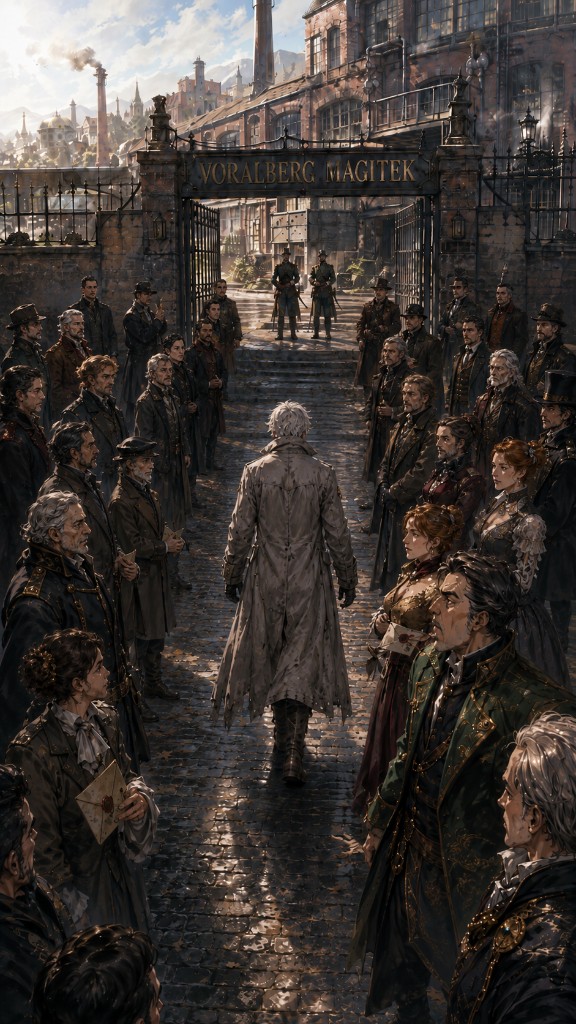
Thirty days after we left Qalathar, the walls of Silberwald rose out of the coastal fog.
Mana-glow lamps still burned beneath the morning sky. The floating island above the city hung behind a layer of cloud, only its dark underside visible, like the belly of some impossible beast waiting overhead.
The sea lay to our left.
I drew a breath through my nose, held it, counted, and let it out through my mouth. The air tasted wet.
Home, if I was still allowed to call it that.
The caravan crossed the southern gate in a slow line of exhausted horses and travel-hardened people. Dorn walked beside me instead of riding. His shoulder had healed enough for him to wear his longsword again, though the way he kept rolling the joint told me it still hurt.
Voller had stayed in Qalathar with the remaining Iron Cross detail. Prince Khalid had needed soldiers who knew exactly what waited east of the city, and Voller had volunteered before I finished asking.
Ganz and Breit had taken their pay in Qalathar, along with enough water and provisions to make the crossing back toward the Sultanate's western trade roads. Breit had left without ceremony. Ganz had shaken my hand hard enough to make my knuckles ache.
Tarek had vanished into the city the night before our departure.
He had left a folded note at the garrison desk in Kumsuri. Soraya translated it for me.
"Some roads are safer when no one knows who walks them."
That was all.
Dorn and the other Knights had returned with me.
We passed beneath the gatehouse. The guards recognized my hair before they recognized anything else.
One of them straightened so sharply his rod struck the stone.
"Hero of Grenzheim," he said.
I kept walking.
Dorn snorted beside me.
"You collect names the way other men collect medals."
We walked another hundred meters in silence. The city woke around us. Vendors arranged their stalls. A fishmonger gutted silver-scaled things at a stall beside the road. A magi-car rattled past on iron-banded wheels, its crystal drive whining beneath the wooden chassis.
At the first major intersection, the road split.
North led toward the Imperial Palace and Iron Cross headquarters.
East led toward the Academy district.
And beyond the Academy, in the old commercial district, inside the old textile mill Augustin had leased under three different shell companies, was Voralberg Magitek's factory.
Dorn noticed where I was looking.
"You are not going to headquarters," he said.
"No."
His brow rose.
"Eckhardt's report needs filing."
I adjusted the strap of the satchel beneath my coat. "The report can wait until I get some rest."
He was quiet for a moment.
The other Knights had begun drifting toward the northern road. They needed to report in, have their injuries inspected, submit equipment returns, endure debriefings, and answer questions from officers who had not spent a day under the desert sun.
Dorn lingered.
"I should report to headquarters," he said at last.
"You should."
"I will."
I looked at him.
His fingers rested on the pommel of his longsword. He had developed that habit over the last month.
"If there are more missions. If you need people—" he started.
"If there is a choice," I said, "I will ask for you."
Dorn extended his hand. I took it.
"I'd be glad to work with you again, Dorn," I said.
"Good," he said.
Then he straightened, brought his fist to his chest in the Iron Cross salute, and gave me a short bow.
"It was an honor, sir."
"Go get your shoulder examined."
"Yes, sir."
He turned toward the northern road.
The other Knights had not gone far. One by one, they looked back.
The oldest among them, a scarred woman with a split lower lip and an ugly burn across her right forearm, raised two fingers from the hilt of her sword.
"If the next assignment has Titans," she called, "send for me."
Another Knight, broad-backed and bald, laughed.
"If the next assignment doesn't have Titans, send for me."
The last one gave a small nod.
Then they were gone into the capital crowd, their weapons and battered cloaks vanishing between carts, street vendors, and soldiers.
I turned east.
The first sign something had gone wrong was the noise.
I heard it three streets before I reached the factory.
Dozens of voices, packed together and growing louder.
"I have been waiting since sunrise!"
"My house supplied crystal shipments to the Ministry for three generations!"
"You cannot deny them to the nobility!"
A woman's voice rose above the rest.
"My husband is a Fifth Circle Mage. You expect me to tell him that our house cannot purchase?"
I rounded the corner.
The old mill occupied half the block.
Its original brick facade had been cleaned but not restored. The upper windows remained tall and narrow. The factory's old smokestack still rose behind the main building, though now it vented pale steam rather than coal smoke.
A fresh metal sign had been bolted above the main gate.
VORALBERG MAGITEK
IMPERIAL TRADE COMMISSION REGISTERED
AUTHORIZED MILITARY CONTRACTOR
The sign had become almost invisible behind the queue.
It wrapped around the front of the factory, spilled down the side street, curved around the corner, and disappeared behind a line of noble carriages. At least seventy people stood outside the gates. Maybe more.
Some were servants holding sealed letters.
Some were house representatives in expensive coats.
Others were soldiers in dress uniform.
A few were clearly merchants, their hands heavy with rings.
Two factory guards stood just inside the gate. They looked exhausted.
Someone in the crowd saw me. The sound died.
A murmur traveled outward from the front of the line.
"That's him."
"The Bastard Knight."
"He is back."
The crowd turned.
Faces followed me as I approached the gate.
A gap opened.
The people nearest the entrance stepped backward, drawing others with them until a narrow path existed between the gate and the street. Servants lowered their eyes. Soldiers stiffened. One merchant, who had been shouting loudly enough to make the guards flinch, suddenly found the cobblestones fascinating.
I walked through the space they gave me.
A nobleman in a dark green coat recovered first.
"Lord Kaspar," he called. "My house has funds prepared. We are willing to purchase five units immediately."
I stopped.
His face brightened.
Then I looked at the line behind him.
"You will hear from us," I said.
It wasn't a promise.
The man's expression fell anyway.
I passed through the gate.
One of the guards started to salute.
"Where is Asena?" I asked.
"Production floor, sir."
"Has anyone forced their way in?"
"No, sir. Yet."
"Keep it that way."
"Yes, sir."
The moment I entered the building, the noise outside became muffled.
Inside, the factory was packed.
The former textile mill had been rebuilt around production lines. Long worktables ran beneath the tall windows. Copper fittings, crystal housings, cooling coils, ironwood stocks, rune-etched plates, and sealed alchemical vials were organized in rows. Mana lamps burned overhead in blue-white strips.
Workers moved between benches carrying parts.
A team of three was assembling Magi-Cooling units near the western wall, fitting copper circulation pipes. Another group tested crystal regulators in a contained ward cage. Near the central line, two artisans were sanding ironwood grips under the watch of a woman with magnifying lenses strapped over one eye.
"Kaspar!"
Eren's voice cut across the floor.
He came running from behind a stack of brass housings, his round spectacles crooked, his ice-blue hair sticking up in three different directions. He had grown since I left. Not much, but enough that the sleeves of his work shirt no longer swallowed his hands.
He stopped two paces away and tried to compose himself.
He failed.
"Cousin," he said, attempting a bow.
I crouched and caught him before he could finish.
He collided with me hard, arms around my neck.
"You are supposed to be in school," I said.
"I am learning."
"From whom?"
He pointed toward the production floor.
"Everyone."
"That is not a reassuring answer."
"It is better than school."
A sharp voice came from the central assembly line.
"Eren Voralberg. You're missing school again?"
My aunt stepped out from behind a workbench. Her ice-blue hair was tied back in a practical knot. Copper dust streaked her cheek. Her sleeves were rolled above the elbows. She wore leather gloves stained black at the fingertips and a small burn marked the side of her wrist.
She looked at me.
For one heartbeat, the fury drained from her face.
Then she crossed the floor in six fast strides, grabbed the front of my shirt, and pulled me down far enough to inspect my face.
"You are thinner," she said.
"I am not."
"You look it."
"I have been eating."
Her eyes narrowed.
Then she released my shirt, put both hands against my cheeks, and pressed her forehead to mine for one quiet second.
When she stepped back, the fury was back in full.
"Your prince has turned my factory into a siege position."
I blinked.
"My prince?"
"Prince Varen. Your cousin. The one who apparently decided that a workshop full of artisans and unstable crystal arrays needed to become the most popular destination in the capital."
I looked toward the front gate.
Augustin von Reichenbach emerged from the office corridor at that moment, a ledger tucked beneath one arm and three more documents clutched in his other hand.
He had acquired more gray at his temples since I left.
His coat was no longer out of fashion.
It was still conservative. But the cloth was new. A small silver clasp marked the collar.
"Kaspar," he said. "You returned earlier than expected."
He looked at Asena.
She pointed toward the front gate with a grease-stained finger.
"Explain to him why we have half the capital trying to climb through the windows."
Augustin inhaled through his nose.
"Prince Varen received the first ten rail-pistols three weeks ago."
"I know."
"He tested them at the Iron Cross proving grounds."
"That seems reasonable."
"It was," Augustin said. "Until the officers began visiting their families."
I waited.
Augustin shifted the ledgers beneath his arm.
"Colonel Hartmann's nephew showed one to a gathering at House Hartmann. A lieutenant from the eastern frontier demonstrated his unit at a private dinner attended by three mining families. A third officer fired six rounds into a steel target at a hunting estate outside the city."
Asena folded her arms.
"By the end of the first week, every noble family with a military son, a private guard detail, or enough money to pretend they matter had heard that Varen's officers carried a weapon that could punch through brick from twenty meters away."
"Then the Chronicle printed a sketch — well, you might imagine what happened after that," Augustin continued.
I rubbed the bridge of my nose.
Outside, someone began shouting again.
"I WILL PAY TRIPLE!"
A second voice answered.
"YOU WILL WAIT LIKE EVERYONE ELSE!"
The first voice shouted something about ancestry.
The second voice shouted something about the first man's mother.
The factory guards were beginning to lose patience.
I looked at Augustin.
"How many cooling units are still outstanding?"
"Five hundred and seventeen confirmed orders. More requests arrive every day. We are meeting the military contract schedule, but only by running two shifts."
"How many rail-pistols can we produce?"
"Current capacity?" Augustin asked. "Assuming we keep producing cooling devices at the same rate and do not acquire more skilled labor? Four standard military units a week. Perhaps five if we didn't have to test the cannons."
I scratched at the side of my head.
We needed production capacity.
And we needed to preserve the military advantage long enough for the Iron Cross to establish doctrine before every noble household in the Empire began buying guns like ceremonial swords.
"Take names," I said.
Asena frowned.
"Names?"
"Every person in that line. Inform them they have to pay a lump sum to enter our waiting list."
Augustin's eyes sharpened.
"Yes."
"That will not make them less angry."
"Military production remains military production," I said. "The standard model goes to the Iron Cross under contract."
Asena's expression eased by a fraction.
"And the list?"
"We sell them the Officer's Model."
Augustin's brows rose.
"The model you carried in Qalathar?"
"Yes. Every Officer's Model comes in a locked presentation chest. Polished wood. Brass fittings. Cleaning tools. Spare copper ammunition. A serial plate. The purchaser's house crest engraved on the case."
Asena stared at me.
Augustin opened the ledger beneath his arm.
"One per household?" he asked.
"One per registered purchaser. If they want another, they go to the end of the list."
"Price?"
"Three thousand Golden Crowns."
Augustin looked up.
"That will eliminate most of the line."
"Good. That is the point."
Asena leaned one hand against the workbench.
"Kaspar," she said slowly, "an Officer's Model is not just a standard unit with a prettier box. The hand-fitting alone adds hours. The longer rails need better copper. The casing requires more ironwood. And if you want engraved brass, a locking chest, a serial plate, and custom balance—"
"We will need more people."
"We will need more than people," she said. "We need more benches. More tool sets. A dedicated glyph team. Crystal-testing stations. This mill is already too small."
I turned to Augustin.
"This," I said, "is a problem for you."
Augustin looked at my hand, then at my face.
"You want a second facility."
"Think bigger," I said.
"We are going to need at least three more production lines," I said. "Not just for rail-pistols. New designs. Weapons, alchemical work, components we have not even imagined yet."
Augustin's expression changed. The pencil in his hand stopped moving.
"We need land," I continued. "A lot of it. Land where we can build what we need, test what we build, and do whatever is necessary without a noble neighbor complaining about noise, ward discharge, or an experimental cannon blowing apart a warehouse."
Augustin looked past me, through the rows of benches and workers, as if he could already see the scale of it.
"What exactly do you think we can build?" he asked.
I looked at the factory around us. At the workers fitting copper, ironwood, and mana crystals together into weapons this world had never seen.
"We need a city," I said. "A city just for us."
For several seconds, neither of them spoke.
Asena's hand slipped from the workbench.
"A city?" she said.
Augustin stared at me as though he had misheard. The pencil remained frozen between his fingers.
"Kaspar," he said carefully, "are you proposing that we purchase an entire city?"
"If one is available," I said. "Or enough land to build one."
Asena blinked once.
"You want to build a city," she said. "For a weapons company."
"For the people who will build the weapons," I said. "Workers. Engineers. Alchemists. Their families. Testing grounds. Laboratories. Foundries."
Augustin's eyes moved across the mill again. This time, he was not looking at the benches.
He turned toward the office corridor.
"I will need surveyors. Legal review. A revised corporate structure. Insurance bonds. Labor contracts. Security licensing. Procurement rights. And someone will need to explain to the Imperial Trade Commission—"
"Tell them the truth," I said.
Augustin paused.
"And what truth is that?"
"We are preparing for demand."
He gave a short laugh while walking away.
Asena watched him leave.
"You enjoy doing that to him."
"He is good at it."
She sighed.
"Go see Rolf," she said.
"The cannon?"
"The cannon," she said. "Or the thing that will eventually become a cannon, assuming it does not kill everyone in the room first."