Silberwald
Emil had been doing good work.
He told himself this as he walked east along the harbor road with his coat buttoned to the chin and his hands deep in his pockets. The wind off the bay carried the salt-iron smell of low tide and the distant clatter of dock cranes loading grain into coastal haulers.
The morning was gray, and even through the fog, if he paused at the harbor wall and squinted past the fishing boats rocking at their moorings, he could make out the steel giants.
That was what the dockworkers called them, the rusted carcasses of ocean-going vessels from the old world, run aground or capsized in the shallows where maritime Titans had torn them apart centuries ago. Their hulls rose from the water at broken angles, barnacled to the waterline and beyond, the superstructures of some still high enough to cast shadows across the harbor mouth at dawn. Nobody sailed past them. The wrecks marked the line where the deep water began and the things that lived in the deep water began to notice you.
Good work.
The phrase had been used by two separate contacts in the past three months. The first time, relayed through the cipher that only contributors to the cause could read. The second time, spoken aloud by a man whose face Emil had never seen.
Good work, Emil. You have a gift for it.
The recruitment numbers proved it. Seven new members. Seven minds opened to the truth.
Seven was an excellent number. The best in his intake year, as far as he could tell from the fragmentary information the cell structure allowed him to see.
And there had been an eighth.
Friedrich Kleist. Third-year transfer. Humanities wing. The young man had appeared in Emil's orbit with a quiet, unassuming presence. Emil had given him the book. Friedrich had returned it three days later with that look in his eyes, the one Emil had learned to recognize, the look of a person whose worldview had just been dismantled and rebuilt along truer lines.
Peace above humans.
Friedrich had spoken the password without hesitation. He'd attended the waterfront meeting. He'd sat in the cellar with the others and listened to the bartender explain, and Friedrich's face had held genuine comprehension.
Then Friedrich had vanished.
Where did you go?
Emil turned the question over as he walked.
Friedrich's disappearance could mean several things.
The worst possibility was capture. If someone had identified Friedrich, followed him to the meeting, traced the connections back through the newspaper cipher to Emil's contributor column and then to the cell itself.
Emil's stomach tightened.
But no. If Friedrich had been taken, the army would have moved on the rest of them. You didn't pull one thread and leave the others hanging. You pulled until the whole web came apart. Emil had studied the historical cases. House Erhardt's network had been dismantled in a single night once the first link was identified.
Nothing had happened. There had been no arrests, disappearances, or unusual attention from the Academy's administrative office or the garrison patrols that circulated through the student quarter.
A mission, Emil decided. Someone above me assigned him. He's useful enough that they moved him before I could.
The thought carried a faint sting of professional jealousy. The cause was larger than any individual's contribution. If Friedrich's talents served the movement better elsewhere, that was a victory, not a loss.
Emil was still useful.
And today, finally, the cause had use for him beyond recruitment.
The message had arrived through the standard channel. A torn corner of newsprint tucked beneath the third stone from the left on the harbor wall's drainage ledge, the drop point that Emil checked every morning on his walk.
A time. A place. A single instruction.
Come alone.
Emil's pulse jumped when he'd read it. He'd stood at the drainage ledge with the salt wind pulling at his coat and the torn paper trembling between his fingers, and for the first time since he'd joined the cause, the mission's scale pressed into his shoulders.
This is it, he'd thought. My turn.
He knew what missions looked like. The cell's operational arm conducted activities that the recruitment wing discussed only in the most oblique terms. Assassinations. Arson. Sabotage of military logistics. The destruction of infrastructure that sustained the Empire's war machine and the institutions that profited from its continuation.
The Pyre had been one of theirs. Viktor von Steinhauer, who had burned five noble houses before someone, presumably Iron Cross, had stopped him. The newspaper coverage had been extensive. The Academy had mourned publicly and investigated privately and found nothing.
Emil had not known Viktor personally. The operational arm and the recruitment arm existed in separate compartments, their personnel invisible to each other by design. But his chest had gone tight with pride when the fires were reported. Somewhere in the structure, someone was acting. Somewhere, the philosophy was becoming force.
Now it was Emil's turn to act.
The question was what they would ask of him.
I'm a historian, he thought as he turned down the narrow lane that led to the waterfront. I write articles about trade policy and demographic shifts in the eastern provinces. I don't carry weapons. I don't know combat spells. My Third Circle is barely functional for anything beyond basic wards and a reading light.
What could a historian do that a trained operative could not?
The question troubled him. It also excited him, because the fact that they had called him despite his limitations meant they had something specific in mind. Something that required his particular skills.
Maybe it's research. Maybe they need someone who understands the historical precedents.
The building sat at the end of the waterfront's southernmost quay, past the shuttered front of a sailmaker who had gone out of business when the Imperial Navy stopped commissioning new hulls.
Emil knocked. Three. Pause. Two. Pause. One.
The iron scraped open.
The interior was dark. The windows had been boarded from inside. The only light came from a single mana lamp on an overturned crate in the center of the floor. One person stood at the edge of the lamplight. The cloak was familiar. Heavy fabric, dark, the hood drawn forward. Emil had never seen the man's features clearly. The voice was what he recognized.
The recruiter.
Someone above the bartender. Someone whose position in the structure Emil could only guess at.
"Emil." The voice came from the hood's shadow. "Close the door."
Emil pulled the iron shut behind him.
He stood with his hands at his sides and waited.
The recruiter reached into the cloak and produced an envelope. Cream-colored paper, unsealed, the flap tucked rather than glued.
"Read this," the recruiter said. "Every word. When you're finished, you burn it." He extended the envelope. "You commit the contents to memory. Nothing written down. Nothing carried on your person. The letter ceases to exist the moment you understand it."
Emil took the envelope. The paper was heavier than he expected.
He opened the flap and unfolded the single sheet inside.
The handwriting was small and unfamiliar.
Emil read.
His brow furrowed.
He read it again.
A mission outside Silberwald.
The north.
The letter was specific.
A village. One of the settlements along the Empire's northern border where the population was predominantly mana mutant. The kind of place that existed on the margins of Imperial attention, too small to warrant a garrison, too remote to attract the Academy's interest, sustained by subsistence farming and the occasional trade caravan that ventured north toward the Republic's frontier posts.
The village had a name. Emil committed it to memory.
Kaltbach.
The instructions were sequential.
Travel north by the trade road. Avoid the coaching inns that maintained guest registers. Use the way-stops maintained by the frontier post riders, where beds were available without questions and payment was accepted in copper.
Upon arrival at the village, a contact would find him. The contact would provide a uniform. Regular Army, standard enlisted grade, the kind worn by the garrison troops that rotated through the northern border stations on quarterly assignments.
Emil's role was precise.
Other operatives, already positioned, would be working the village's population in the days before his arrival. The grievance was war taxes. The levies imposed on frontier settlements to fund the southern campaign had doubled in the past year, and the burden fell disproportionately on communities that received nothing in return.
Emil's task was to arrive during the unrest, wearing the uniform, carrying a military-issue wand, and fire into the crowd.
Then he would disappear.
The shot would ignite the revolt.
A garrison detachment would already be en route to the village, dispatched to calm the unrest through the standard protocol of stern words and visible force. Emil's shot, fired in Imperial uniform from within the garrison's perimeter, would be indistinguishable from an order given.
The crowd would not scatter.
These were frontier mutants, people who had survived iron-tusk boars and border raids and winters that killed the unprepared.
They would fight back. And the garrison soldiers, young conscripts who had never faced an angry mob of mutants with claws and tusks and three times their muscle density, would panic. And in the space between the first spell and the first mutant body hitting the ground, the situation would pass the point from which no amount of shouted commands could pull it back.
A full revolt.
The witnesses would testify that an Imperial soldier had opened fire on unarmed civilians during a tax protest. The story would travel south along the trade road and arrive in the capital within a week.
Imperial soldiers attacking mutant civilians. The narrative wrote itself.
Emil lowered the letter.
His hands were not steady.
"They're mutants," he said.
The recruiter didn't move.
"The village." Emil's voice came out thinner than he intended. "The population. They're mutants. Not nobles." He looked at the hooded figure. "They're the people we're supposed to be protecting."
Neither of them spoke.
"You're hesitating," the recruiter said.
"I'm not—" Emil stopped. "I joined this cause because the Empire treats certain lives as expendable. The mutant populations. The sins. I joined because The Elegy showed me the truth: that the eleven civilizations came as refugees, and we turned them into enemies because it was easier than sharing." His jaw clenched. "How does shooting mutant farmers advance that truth?"
The recruiter was quiet for three seconds.
"Emil." The voice from the hood shifted. Warmer. The register of a teacher correcting a bright student's reasoning. "Do you believe the Empire will change because we asked it to?"
"No."
"Do you believe the institutions that profit from the war, the noble houses, the military apparatus, the Academy's research funding, will voluntarily surrender the power they've built?"
"No."
"Then what changes them?"
Emil didn't answer.
"Pressure," the recruiter said. "The Empire changes when it is forced to change, when the cost of maintaining the current order exceeds the cost of transformation, and when the people who bleed and starve and die while the nobility debates succession finally rise and demand something different." The hood tilted. "But they will not rise while they are comfortable. They will not rise while they believe in the system, broken as it is."
He stepped closer. The lamplight caught the edge of his jaw. Clean-shaven.
"The mutant communities are the most oppressed population in the Empire. They are taxed without representation. They are drafted into the Regular Army at three times the rate of baseline humans and assigned to the worst postings. Their children are denied Academy enrollment. Their settlements receive no infrastructure and no protection worth the name." The recruiter's voice dropped. "And still, they pay taxes and send their sons to the southern front because they have been taught, by centuries of propaganda, that the alternative is worse."
He paused.
"We need them to stop enduring."
Emil stared at the letter in his hand.
"You will make them see how the Empire consumes them."
The logic was sound. The reasoning followed from premises Emil had accepted two years ago when he'd first read The Elegy.
But the feeling remained.
"Why me?" Emil asked. "I'm not trained for this. There must be operatives who—"
"Because you understand what moments like this mean. Because you will make every shot count. You will understand the significance of what you are doing, and that understanding will make you careful. The operatives who do this work without comprehension are dangerous. They make mistakes." The hood dipped forward. "You will not make those mistakes, Emil. Because you know why it matters."
Emil looked at the letter one final time.
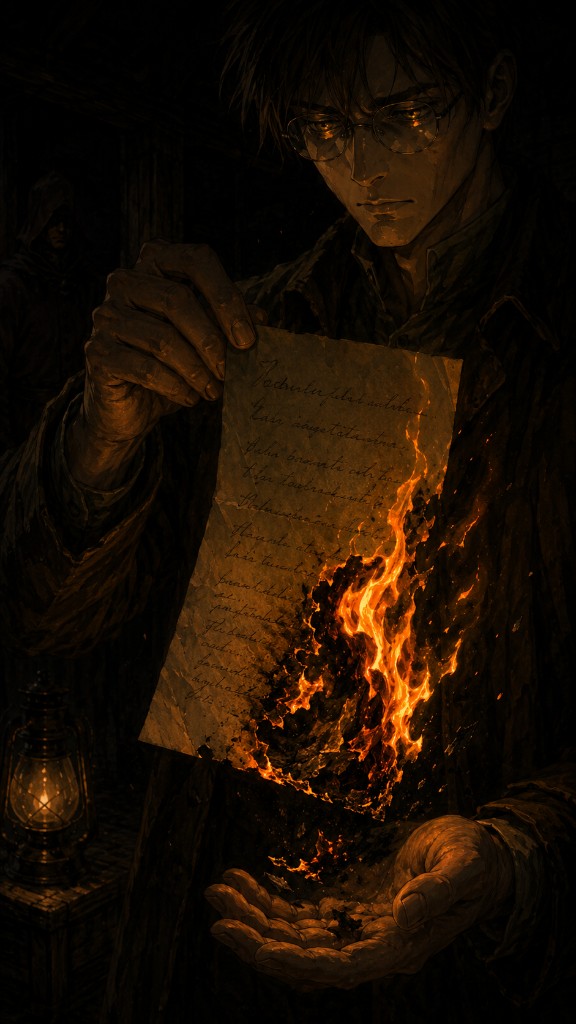
He folded the letter carefully. He held it over his hand and conjured a small flame. The paper caught at the corner. The fire crawled inward, consuming the words, the instructions, the names, turning them to ash.
Emil watched until the last fragment darkened and fell.
He pressed his empty hands against his chest, over the place where the letter had rested.
"I won't fail," he said.
"I know you won't."
They clasped hands.
Emil turned, pulled the iron door open, and stepped into the gray morning.
He walked north.
Behind him, in the warehouse, the recruiter watched the door until the footsteps faded. Then he reached into the cloak and withdrew a comm crystal the size of a walnut, set in a brass frame no larger than a coin.
He pressed the activation point.
"The student is en route," he said.