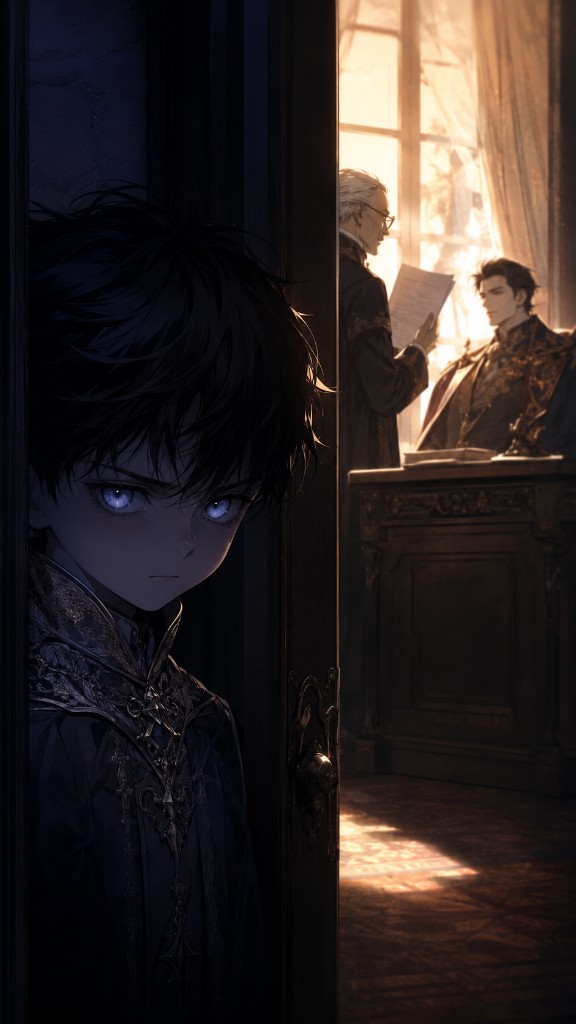
Three days.
That was how long it took for the Imperial Guard to approve a supervised outing for the heir to the Northern Empire. Three days of paperwork, route assessments, threat evaluations, and hushed conferences between men in uniform.
The approval came on a Tuesday. I read the official document and set it aside on my desk. I already knew the date I wanted.
The First Day of Zimavek.
The Festival of Winter's Mouth. For three days the capital marked the onset of the long northern winter.
Markets spilled out of their permanent halls and colonized the boulevards. Street vendors sold roasted chestnuts and cardamom cider and small painted figurines of the Frost Stag. Children received gifts. Factories closed. The railyards went quiet. Two million people poured into the streets of Severgrad to eat, drink, sing, and brawl.
The busiest day of the year. To me, the most useful.
I circled the date on my calendar and waited.
My tutors had been assigned a six-year-old of above-average intelligence.
Lady Zareva was the first to notice.
She taught languages. High Celdaran, Trader's Common, the Vessen dialect of the Southern Kingdoms, Old Imperial. In my first life, I had studied under her for nineteen years.
The difficult part was pretending I didn't know.
"Repeat after me, Your Highness," Lady Zareva said on my third lesson. She held up a card with a High Celdaran phrase written on it. "Vel'aneth surimai. I greet you with respect."
"Vel'aneth surimai," I repeated. Then, because her pronunciation had carried a slight northeastern inflection that I knew from my studies was characteristic of the Celdaran merchant dialect, I added without thinking, "Vel'aneth surimai'eth. Should it not carry the formal suffix when addressing—"
I stopped.
Lady Zareva was staring at me.
Too much.
"Where did you learn that?" she asked slowly.
"I... read it. In a book. In the library."
"The formal suffix of the Celdaran court register is not covered in any text that I know, Your Highness." She was quiet for a moment. "Do you know which book it was?"
I blinked at her. I made my eyes wide. I let my lower lip tremble, just slightly, just enough.
"I don't remember the book," I said in a small voice. "Maybe I'm wrong."
"You're not wrong," she said quietly. "The suffix is correct."
After that, I was more careful. I introduced errors deliberately. I mispronounced words I could speak flawlessly, asked questions I already knew, stumbled over grammar.
It was exhausting. And I wasn't always successful.
Professor Borisov set me a problem in basic arithmetic during a Mercantile Law introduction. I solved it in my head before he finished writing it on the slate, and the answer left my mouth before I could catch it.
He stared at me over the tops of his spectacles. His left eyebrow twitched, the way it always did.
"Correct," he said. "Would you care to explain your method?"
"I just... guessed."
"You guessed?"
"Yes."
He wrote it in his notes. He underlined prodigy twice.
The word spread. Within a week, it had reached the servants. Within two, it had reached the court. The heir, the boy with the F-rank diary, was proving to be extraordinarily gifted in his studies.
My first instinct was to strangle it. To introduce enough mistakes, enough childish behavior, to make the whispers die. I had spent the last weeks building the mask of a normal six-year-old, and the idea of anyone paying close attention to me made my skin crawl.
But then I stopped. I sat at my desk one evening with the Diary open and the pen idle in my hand, and I thought about it properly.
I was six. My Relic was F-rank. I had no combat ability and no allies. I was a child in a palace full of adults who were already planning to murder my family. The only asset I possessed was the knowledge in my head, and if I buried that knowledge under a performance of mediocrity, I buried the only thing that made me dangerous.
Let them think I'm a genius. Let them know that even with an F-rank Relic I'm someone extraordinary.
But the story had consequences I hadn't anticipated.
She appeared in my doorway one evening with a slate tucked under her arm and a look of determined nonchalance on her four-year-old face.
"Nivus."
"Yes?"
"I need help."
She marched into my chambers without waiting for an invitation, planted herself on the floor beside my desk, and set the slate down in front of her. On it was a set of letter drills the nursery tutors assigned to children her age.
"Madame Petrovna says I need to practice my letters before tomorrow," Yelena announced. "She says if I get them wrong again, I can't have pudding."
"And you want me to help you practice."
"That or you could tell me the answers so I don't have to practice."
I looked at my sister. Four years old. Gray eyes identical to mine, set in a face still rounded with baby fat. Her hair was pulled into two uneven braids that someone had tied with ribbons that were already coming undone.
"No way I'm giving you the answers. Sit down," I said. "We'll practice together."
Yelena's face scrunched. She clasped her hands behind her back and rocked on her heels, and her eyes went wide and round, and she tilted her chin down so she was looking up at me through her lashes in a way that was clearly rehearsed.
"But Nivus," she said, her voice dropping to a whisper, "you're so smart. Everyone says so. And I'm so small. And the letters are so hard. And if I don't get pudding I'll be so, so sad."
She blinked. Twice.
She's four and she's already better at this than half the ministers.
"That's not going to work on me."
"Please?"
"Yelena."
She held the pose for another three seconds, eyes enormous, lower lip pushed out just far enough to suggest imminent tragedy. Then she broke, and her face collapsed back into its natural expression of cheerful calculation, and she dropped onto the floor cross-legged with the slate in her lap.
"Fine," she said, as though she were granting me a tremendous favor. "But I want extra pudding for the effort."
"You haven't put in any effort."
"The effort of being adorable."
Soon after Sonya began appearing beside Yelena. She sat on the floor with a picture book and listened while I walked Yelena through her letters.
Natasha was too young for lessons, but her nursemaid began bringing her to my chambers in the afternoons, and the toddler would sit in my lap and pull at my hair and babble at the Diary when I conjured it.
I hadn't planned for this.
In my first life, I had been close to my sisters in shared games and stolen afternoons, not shared study.
We had chased each other through the palace gardens. I had let Yelena beat me at cards and pretended not to notice when Sonya smuggled novels into the breakfast table behind her napkin. I had carried Natasha on my shoulders through the corridors until the nursemaids scolded me for it.
But when it came to lessons, to the serious work of learning, there had been a natural distance.
Sonya had been the real scholar among us.
This time was different. This time they were glued to me even in study, drawn by the whisper of the word prodigy.
But the hours I spent with my sisters were hours I could not spend elsewhere.
The ministerial briefings continued without me. My father attended them daily, and I had no pretext to request a second invitation. A six-year-old heir demanding regular attendance at classified state briefings was alarming.
The noble families who visited the palace brought their children for supervised play, and those children brought gossip, trade disputes and political marriages, the small currency of aristocratic life. But I was six. They spoke to me the way adults speak to children. Simple sentences. Nothing that mattered.
I was trapped. Surrounded by the machinery of empire, with perfect knowledge of what was coming and almost no capacity to act on it.
The Revolution was a disease that had been incubating in the Empire's bones for years.
Every day I spent in a child-sized chair practicing letters I already knew was a day the rot spread deeper. I needed to start influencing the board.
The question sat with me at night as I stared at the canopy while the palace slept, and during Lady Zareva's pronunciation drills.
The answer came two days before my outing.
I was at breakfast. My father had not yet come down. The morning dining room was quiet, the only sound the soft clink of silverware and the distant murmur of the kitchen staff.
Then I heard voices.
They came from the corridor that connected the dining room to my father's private study. The door to the study was ajar. Through the gap I could see my father's desk, the tall windows behind it, and two figures standing before it in conversation.
My father. And Professor Borisov.
They were speaking in low tones. My father had his arms folded, his expression attentive, nodding at something Borisov was saying. Borisov held a sheaf of papers in one hand and was gesturing with the other.
I set down my toast.
Professor Borisov. He had taught my father, and my grandfather before that. Forty years in the Household. Three generations of Vasilievs.
He and General Gromov. They're the only two who've served that long.
Borisov had my father's ear. He had the respect of the ministerial class, many of whom had been his students.
I watched through the gap in the door as my father laughed at something Borisov said and clapped the old professor on the shoulder.
That's my way in.
My toast went cold. I did not notice.
If I can win Borisov's support. If I can show him what I'm capable of...
I would still be six. But the words would be carried by a man whose voice had shaped Emperors.
My father emerged from the study a few minutes later, greeted me warmly, sat down, and began his morning coffee. Borisov passed through the dining room on his way to the tutorial wing. He glanced at me as he passed, gave a small, absent nod, and continued on.
Two days until Zimavek. I watched him go.