Rank F.
The words swam. I blinked. I could still feel the bullet. The small hole in my chest.
"Nivus." My father's voice. "What does it say?"
You're dead. I watched you die. I watched the back of your skull come apart.
My throat closed. I thought I would drop the Diary and run to him and throw myself into his arms and press my face against his coat and never let go.
I swallowed. The words came out exactly as they had before.
"R-Relic... rank F." My voice cracked. "Ev-Evolving trait. It's called... the Diary of Memories. It... it records memories. In the book. When I write them. It can be conjured whenever I want." I looked down at the plain leather cover. "That's all it does."
The silence that followed was the same silence.
There it is. The disappointment. Again.
Father Arkady's hand came to rest on my shoulder, and I flinched, and he said the same words about souls and reflections and the Gods not making mistakes.
My father rose. He descended the steps. He knelt before me.
"You are my heir," he said quietly. "That hasn't changed."
Everything has changed. You just don't know it yet.
He reached for me, and I stepped back.
"I need to go." My voice was too loud.
"Nivus."
"I'm sorry. I need to go. I'm sorry."
I turned and walked. Then I walked faster. My legs were short and the Hall of Awakening was enormous.
Nobody stopped me. I heard my mother say my name once, softly, but she didn't follow. My father didn't call out again. I could feel Father Arkady's gaze on my back.
I reached the doors. The guards posted there glanced at each other, hesitated, then stepped aside. No one in the Imperial Household was going to be the one to stop me.
She sprang back when the door opened. Her enormous gray eyes locked onto mine.
"What happened? What did you get? Is it a sword? Sonya said—"
I walked past her.
I heard her voice falter behind me. "Nivus? Nivus."
If I looked at her, I would break apart right here.
Sonya was behind Yelena, quiet, watching. Natasha was balanced on her nursemaid's hip, chewing on a cloth ribbon. I passed them all without a word.
My chambers were on the third floor of the East Wing. I climbed the stairs two at a time, which these legs made slow. I was panting when I reached the landing, chest heaving, lungs burning.
I shut the door behind me. Locked it. Crossed the room.
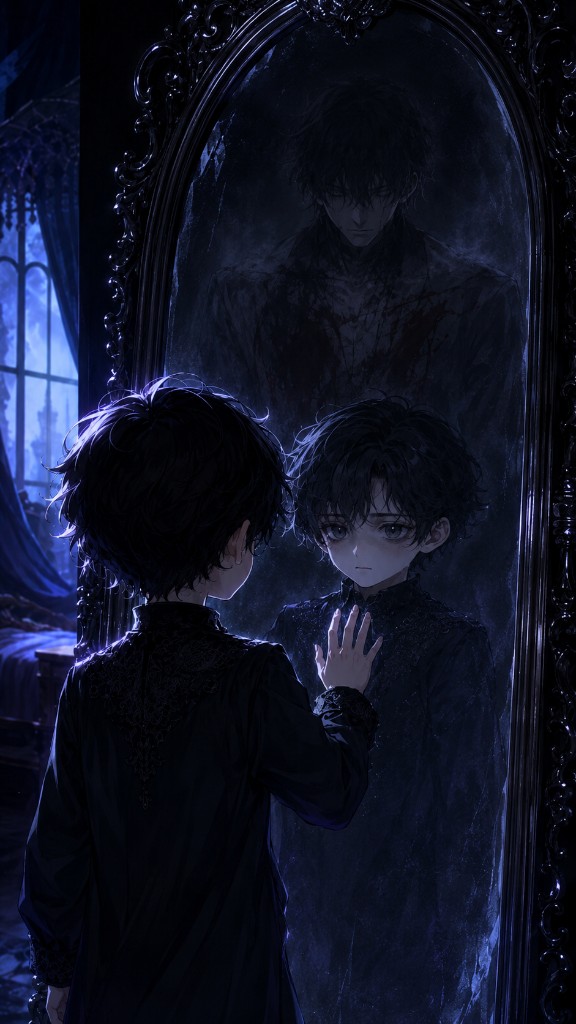
The mirror stood beside the wardrobe. I stopped in front of it.
A child stared back at me.
Six years old. Round face. Dark hair that fell in unruly curls across his forehead. Gray eyes, too large for his face. Pale skin that had never seen direct sunlight for more than an hour at a time. A body that was all soft angles and baby fat and fragility.
I raised my hand. The child in the mirror raised his hand.
I'm six years old.
The room behind the reflection was my childhood bedroom. The four-poster bed with its heavy blue curtains. The toy soldiers arrayed on the shelf above the desk, a set of fifty carved from painted wood, a gift from General Gromov on my fourth birthday. The stack of picture books. The window seat, piled with cushions, where I used to sit and watch the palace gardens.
Everything was exactly as I remembered it. Because I had written about it.
I sank to the floor. My back hit the wardrobe. I sat there with my knees drawn up to my chest and my arms wrapped around them and stared at nothing.
I could still hear the sound. The wet, heavy crack of the rifle. The way it echoed off the pines.
My hands were shaking. I pressed them flat against the floorboards.
I stayed on the floor for a long time. The light from the window moved across the room as the morning wore on. At some point I heard footsteps in the corridor, but they paused at the door, listened, and moved on.
Eventually I stood. I crossed to the desk. I sat in the chair, which was built for a child and fit me perfectly in a way that felt like mockery, and I willed the Diary into my hands.
It appeared. The same small leather book, the same unremarkable pen. I opened it to the first page.
The first page was blank.
The memories were still there. All of them.
I picked up the pen.
First life. I died at twenty-five. Bullet to the chest. Pine forest north of Severgrad. Captain Viktor Lebedev. The Imperial Guard. The coup was planned for years. The Red Army breached the eastern and southern gates with help from inside the garrison. At least half the garrison defected. The safe house was a trap.
Father. Mother. Yelena. Sonya. Natasha. All dead.
I will not let it happen again.
The days that came after felt like a play.
It was difficult to pretend to be six years old.
I had the muscle memory of an adult. When I spoke, my sentences were too complex. I caught the servants staring.
I had to consciously remember to be clumsy. Small words. Fidget. Ask obvious questions. Look bored when the talk actually mattered.
You're a child. Act like a child.
I had been twenty-five years old. I had been educated by the finest minds in the Empire. And now I was sitting in a child-sized chair eating toast with honey and trying to remember how a six-year-old was supposed to feel about anything.
It was obvious I was acting colder. The servants noticed, then the tutors, then my mother.
"Nivus." She sat beside me on the window seat in my chambers one afternoon, three days after the Awakening. "Are you all right?"
"I'm fine, Mother."
"You've been very quiet."
"I'm thinking."
"About what?"
About the way Lebedev said it was nothing personal.
"About my Relic," I said.
"I see," she said.
She kissed the top of my head and left.
I stared at the door after it closed and felt the distance grow.
Two weeks after the Awakening, I woke before dawn.
The palace was still dark. The corridors were lit by gas lamps turned low. A lone servant passed me on the stairs, carrying a tray of empty teacups, and blinked in surprise at the sight of the six-year-old heir padding barefoot through the East Wing.
The family breakfast was at seven. My father rose at six, dressed, reviewed correspondence for forty-five minutes, and then descended to the morning dining room. He followed the same routine every day.
I was seated at the dining table when he arrived.
He paused in the doorway.
"Nivus."
"Good morning, Father."
He studied me for a moment. Then he crossed the room and sat down at the head of the table. A servant stepped in and poured coffee. Another set out a rack of toast and a small pot of honey.
"You're up early," he said.
"I couldn't sleep." That part, at least, was true. "Father, I have a question."
"At six in the morning?"
"I want to come with you today."
He set down his coffee cup. "Come with me where?"
"To your meetings." I folded my hands on the table, mimicking a posture I had seen him use a thousand times. "I'm the heir. You always say that. I should start learning what that means."
He eyed me with uncertainty.
"Nivus, the ministerial briefings are not... they're not for children. The ministers discuss matters of state. Policy. Finance. Military deployments. It would bore you immensely, and some of the discussions are frankly not appropriate."
"Please," I said. I let my voice go small. Let it crack slightly. "Just today. I'll be quiet. I won't say anything. I just want to watch."
The calculation played out on his face.
The ambition won.
"Very well," he said slowly. "Today. You may sit and observe. But you are not to speak unless spoken to, and if you become restless, you will leave quietly. Understood?"
"Yes, Father."
The Imperial Council Chamber occupied the entire western face of the palace's second floor. Vaulted ceilings held scenes from the Unification. A dark hardwood table sat forty. Imperial-blue curtains on the tall windows. The Morning Council opened every working day at eight o'clock sharp.
They were already gathering when I arrived at my father's side.
Thirty men and women responsible for the governance of thirty-two million people across eleven provinces.
I recognized every single one of them.
Count Pyotr Volkov handled Finance. A heavyset man with receding hair and the complexion of someone who had not refused a glass of wine in thirty years. His family controlled the largest banking consortium in Severgrad.
Baroness Katarina Durnova handled Industry. Thin, severe, with iron-gray hair pulled into a bun so tight it seemed to stretch the skin at her temples. She owned six of the eleven major steel foundries in the northern provinces. Her family had quietly blocked three of my father's proposed industrial reforms.
General Andrei Zhukovsky handled War. A tall man with a soldier's bearing and a politician's smile. His medals were from battles that did not matter.
Lord Semyon Kazakov handled Internal Security. He sat at the far end of the table. I knew almost nothing about him. In my first life, his name had barely appeared in my records.
Minister of Agriculture. Minister of Education. Minister of Trade. Minister of Public Works. Minister of Colonial Affairs. Minister of the Imperial Household. The titles blurred together, thirty faces, thirty noble families whose wealth and influence predated the Empire itself and whose loyalty to the crown was, at best, a function of mutual convenience.
These are the people who run the Empire. And Father doesn't see it.
The session began. My father sat at the head of the table. The ministers arranged themselves in order of seniority. An aide read the day's agenda from a leather portfolio. For two hours I sat against the wall and listened.
They discussed the eastern railroad.
"The East-West Line extension remains on schedule," said the Minister of Transport, a portly man named Baron Gregor Felsin, consulting a set of papers. "The second track between Severgrad and Vostochny is expected to be operational by year's end."
Liar.
A spike of pain lanced through my temple, sharp and sudden, and with it came a memory.
Vostochny Central Station. Father cut a ribbon. The Minister of Transport gave a speech. The East-West Trunk Line's second track, inaugurated four years late.
Four years of delays. And my father had never demanded an accounting.
The pain in my temple faded. The memory receded.
They've been lying to him. For years. Probably decades. Small lies, wrapped in bureaucratic language and qualified with technical excuses. And he lets them, because confrontation makes him uncomfortable, because he trusts the institutions.
I looked at my father. He was nodding as Baron Felsin outlined the projected costs of the extension. His expression was attentive, engaged, the face of a ruler who cared about the details. He wasn't asking why last year's completion target had been missed.
He was listening.
I love you, Father. And I would give every one of my remaining lives to keep you safe.
But they were right about you. You're a good man, and you're a terrible Emperor.
And if I don't fix that, you will die once more.
The session continued. Finance. Agricultural yields. A border dispute in the western provinces. A request from the Ministry of Education for additional funding. Each item was presented, discussed in language carefully calibrated to sound productive.
I sat in my chair and absorbed it all. The Empire's dysfunction was becoming visible, like the outline of a corpse beneath a sheet.
When the session ended, the ministers rose and filed out, many of them pausing to bow to my father, a few of them glancing at me with expressions ranging from benign amusement to barely concealed curiosity. A six-year-old sitting quietly through a two-hour ministerial briefing was unusual. I made sure to yawn visibly as the last of them departed.
My father looked down at me.
"Well?" he said. "Was it everything you hoped?"
"It was very boring," I said, and I let my face go slack with childish disappointment, and he laughed.
"I told you."
"Father."
"Yes?"
I tilted my head. Made my eyes wide. Deployed every scrap of six-year-old charm I could muster.
"Can I see outside?"
"Outside?"
"Outside the palace. The city. I want to see what it's like."
"Nivus, the city isn't for you."
"I've never been. I've only seen it from the carriage."
"And for good reason. You're the heir. The streets aren't either."
"Please."
He hesitated.
"Please, Father. I'll take guards. As many as you want. I just want to see."
I let my voice break slightly.
I hated myself for using it. But I needed it.
My father studied me.
"Very well," he said at last. "Supervised. You may choose a date. You will return to the palace before nightfall. Is that understood?"
"Yes, Father."
"And you will wear a hat."
"A hat?"
"Your face is known from the commemorative portraits." He reached down and adjusted the collar of my jacket. "A hat will help."
"Thank you, Father."