Days passed.
I kept the dyed hair and the Academy robes and walked the corridors of the Silberwald Magic Academy.
I sat in the back rows of open lectures, ate in the refectory (the food was exactly as bad as The Academy Voice claimed), and browsed the library stacks with the borrowed pass.
I didn't know when Emil's people would make contact. The book had said wait for your call. That could mean a day or a month.
So I explored.
The Academy was vast. I had known that from my first enrollment, but the original Kaspar had moved through it with his head down and his eyes on the floor. He had never looked at the institution itself.
I looked.
The Academy produced mages. That was its stated purpose and its primary output. It took the children of noble houses and the rare talented commoner and it ran them through years of elemental theory, runic architecture, Circle advancement, and applied spellcraft, and at the end it stamped them with a degree and sent them into the world to serve the Crown, the military, or whatever private interest could afford them.
That was the common path. The guaranteed one. A Third Circle graduate walked out of the Academy gates into a life of modest comfort and institutional respect. A Fourth Circle walked into wealth. A Fifth, into power. The system was designed to produce these outcomes, and it produced them reliably, year after year, generation after generation.
But there were others.
Students who knew they would never push past the Second Circle, or who had decided that Circle advancement wasn't the axis on which they wished to build a life. Students who'd come for the Academy's name.
These students ended up in the humanities wing.
I had passed through it during my first enrollment and thought nothing of it.
Now I walked those corridors deliberately, and I read the plaques beside the doors, and I sat in the lectures, and I listened.
Imperial History. Political Economy. Diplomatic Theory. Journalism and Public Rhetoric. Military Strategy and Doctrine.
The courses were small. Fifteen students in a classroom built for sixty. The professors were, with rare exceptions, men and women who had chosen scholarship over spellcraft. Retired officers, former diplomats, aging theorists who had traded the laboratory for the lectern.
The students were nobles. Almost without exception. The Academy's commoner admissions went overwhelmingly into the magical tracks, where talent could be measured and advancement was meritocratic. The humanities attracted the sons and daughters of houses that wanted the Academy's stamp on their children but had no illusions about their children's magical futures. A Second Circle heir with a degree in Political Economy was more useful to a trading house than a Second Circle heir with a degree in Advanced Runic Theory that he would never use.
These are the people who shape what the Empire thinks, I realized, sitting in the back row of a lecture on Imperial History while a professor with a gray beard and half-moon spectacles described the Treaty of Grünwald in terms that made the Empire sound like the only civilization that had ever made a correct decision.
That was one extreme.
I found it everywhere in the older faculty. A school of thought that held, with the unshakeable certainty of men who had never been asked to defend their position, that the Empire had been right in every war and every treaty. The reasoning was always the same. The decision had been the best available. The intelligence had been incomplete. The commanders had acted with the information they had. Mistakes were acknowledged in the abstract and excused in the particular.
I sat in those lectures and watched the students nod along, and I thought about the map Falken had unfolded by the campfire. The Last Kingdoms. A sliver of coastline where a civilization had once spanned a world.
If everything we've done has been correct, I thought, then how do you explain the map?
The other extreme lived in the younger faculty and in the student publications and in the after-hours discussion groups that met in the refectory after the tables were cleared.
Everything the Empire did was wrong. Humanity was its own worst enemy. The war was aggression against refugees. The Sins were victims. The portals were a cry for help, and humanity had answered with swords.
I heard the word coexistence so often in the first three days that it began to lose its shape, the way a word does when you repeat it past the point of meaning. Coexistence. As though the concept could be willed into existence by saying it enough times, as though the elves massing on the southern front and the Titans wandering the desert and the orcs enslaving humans on the eastern continent would hear the word and lay down their arms.
Elara's fingerprints, I thought.
The princess was too smart to sign it. She funded the departments and the chairs. People who received those things understood what conclusions their benefactor found agreeable.
Each cohort emerged more willing to treat the war as humanity's fault, and the Sins as fellow travelers on a shared world.
And in ten years, I thought, watching a group of second-years debate the ethics of the southern front over cups of the refectory's terrible tea, these are the people who will sit in the ministries and the courts and the command posts. These are the ones who will decide whether the next generation fights or folds.
The realization sat cold in my chest.
Viktor von Steinhauer had burned children alive. That was the visible edge of it. But the machine that had produced Viktor was running in broad daylight.
Six days after I read the book, Emil Voss found me.
I was in the library, in the humanities stacks, a volume on pre-portal diplomatic history open on the reading desk in front of me. I'd chosen the location deliberately. A student who spent his time in the humanities stacks, reading history, was exactly the kind of person Emil was looking for.
"Friedrich."
I looked up. Let the surprise come naturally. "Emil. I wasn't expecting—"
"Have you finished the book?"
"Twice," I said.
He came closer. His eyes moved across my face with the evaluating attention of a recruiter assessing a prospect.
"What did you think?"
I set the history volume down and folded my hands over it. I let the pause build.
"I think," I said carefully, "that I've been looking for something like this for a long time. I'd felt the arguments before, but I'd never seen them laid out so clearly." I paused again. "Especially the final chapter. Peace above humans."
Emil's face opened.
A softening around the eyes.
"I knew you'd respond to that part," Emil said. He reached into his satchel and produced a folded card. "There's a gathering. Soon. People who share our understanding and have chosen to act."
I took the card.
To a casual eye it was nothing. A few lines of polite text, an invitation to an evening lecture on municipal reform, hosted by a civic society whose name I didn't recognize.
I applied the cipher.
An address emerged. A building near the waterfront. And a date. Four days from now.
A weekday. The capital's attention would be elsewhere.
"Thank you," I said, and the gratitude in my voice was real, though not for the reason Emil believed.
The building was in the stretch between the last of the working warehouses and the first of the derelict ones. Old brick, three stories, the ground-floor windows boarded over. A faded sign above the door advertised a shipping agent that hadn't existed in years.
I arrived twenty minutes early and walked the block twice.
The front door was unremarkable. Peeling paint, brass handle tarnished green. A man stood beside it, leaning against the frame. He was young, mid-twenties, with close-cropped dark hair and the build of a student who'd spent more time in libraries than on training grounds. His eyes tracked every face that passed.
I approached. The guard's gaze found me and held.
"I'm here for the civic lecture," I said. "Municipal reform."
The guard's expression didn't change.
A hand fell on my shoulder from behind.
"He's with me."
Emil. The guard looked past me, received a nod, and stepped aside.
Emil opened the door.
The ground floor was empty. Bare brick walls, a concrete floor swept clean, the ghost of whatever had once operated here.
We went down.
The stairs were narrow and turned twice. The air changed as we descended. It carried the faint smell of old wood and spilled beer. At the bottom, a door that had once been the entrance to something commercial. A bar.
Emil pushed through.
The room opened up.
It was larger than I'd expected. Low ceiling, heavy beams, the bar itself still intact along the far wall.
Tables and chairs had been arranged in a rough semicircle facing the bar. Ten tables. Two people at each.
Ten pairs, I counted.
Emil steered me to a table near the center of the arc, pulled out a chair, and sat. I took the other.
I let my eyes move across the room, cataloguing every face.
The recruits were a mix. Students, mostly. Young faces with the soft features and clean fingernails of the Academy's noble intake. A few older, harder. One woman near the far table had calluses on her hands and the wary eyes of someone who'd worked for her living.
None of them radiated anything above Three Circles. Modest cores. Minor fire affinities, water affinities, earth. Nothing that posed a serious threat.
The man behind the bar was different.
He stood where a bartender would stand, both hands on the scarred wood, in charge. Mid-thirties. Dark hair swept back from a high forehead.
Fourth Circle. Wind affinity. He'd been practicing.
The bartender waited until the last pair had settled. Then he spoke.
"Thank you for coming," he said. "You're here because someone you trust believed you were ready." He looked across the semicircle, meeting eyes, holding contact for one beat before moving on. "Each of you has read the book. Each of you has spoken the words. That's enough to bring you through the door. What happens after the door is up to you."
He paused.
"We don't have a name you'd recognize, or a banner, or a seat on any council. What we have is a vision. The world is dying because of the response to the Sins. Seven centuries of war. Seven centuries of walls and trenches and a philosophy that says everything beyond the border deserves extermination." He paused. "We believe that philosophy is wrong. Coexistence is possible, and necessary. And we believe that the Crown, the military, and the old houses will never voluntarily adopt it."
He's good, I thought. He's very good.
The cadence was precise.
Belief is more dangerous than power.
A young man near the far wall raised his hand. "How large is the organization?"
The bartender smiled. "Smaller than it needs to be." He moved between the tables, hands open. "We operate without a single head. No leader. No hierarchy. Each cell supports the others but does not depend on them. Information flows in one direction, upward. Action flows outward. If one link breaks, the chain holds."
Decentralized, I catalogued. Cell structure. Compartmentalized intelligence. They've studied insurgency doctrine.
"If someone is captured," the bartender continued, "they can't betray what they don't know. You will learn the names of the people in this room and the person who brought you. Beyond that, the structure remains invisible to you until trust is earned. And trust is earned slowly."
He leaned against the bar, getting closer.
"The movement isn't waiting. While the princes fight each other for a dying throne and the princess builds the foundation for what comes after, we are already at work. Every book distributed is a seed. Every mind that opens to the possibility that the war is wrong is a step toward the world we intend to build."
A girl to my right, perhaps nineteen, minor-noble posture, raised her hand. Her voice trembled slightly.
"Is it really possible? Coexistence. With all of them?"
"Every intelligent species that came through those portals came because its world was dying," he said. "They didn't choose to invade. They chose to survive. That is a motivation we understand, because it is our own." He spread his hands. "The elves built civilizations that lasted millennia before their world failed them. The others, each brought knowledge, culture, ways of understanding mana that we have barely begun to study. These are not beasts. They are peoples."
The orcs who enslaved Yulia's family would be fascinated to hear about their capacity for negotiation, I thought. The elves who coached four refugees into a suicide ritual that dropped a defensive grid would be charmed.
I kept my face still.
Another hand. A man across the semicircle, older than most of the recruits, with the rough hands and sunburned neck of someone who'd spent time outside the capital.
"What about the Titans?" he asked. "They don't seem like something you can sit down and talk to."
The bartender nodded.
"Even our own ancient world produced legendary creatures of enormous size," he said. "Elephants. Whales. Beasts that dwarfed us physically and yet shared the earth with us for millennia. Humanity learned to coexist with them. Through respect for the boundaries of the natural world." He paused. "The Titans are not conquerors. They are forces of nature. They wander. They feed. They do what their biology demands. Our ancestors learned to live alongside creatures like that. We can learn again."
Elephants.
I almost laughed.
The Sultan had pushed a desert across hundreds of leagues to build a wall of sand between humanity and the things that would eat it. And this man was comparing the effort to living alongside elephants.
Demagogue, I thought. A polished, warm, well-spoken demagogue.
I said nothing.
I nodded at the right moments and kept my hands still. I widened my eyes on cue.
"When the right person sits at the head of the Empire," he said, "everything changes. Not overnight. But the foundation will be there. The groundwork we are laying now, that groundwork becomes policy, then law."
He paused.
"A republic," he said quietly. "A government that represents all peoples. All species. A shared world, governed by shared consent."
Impossible, I thought.
Not the republic. Republics existed. Wolkenmark was one. The impossible part was the idea that Princess Elara, a woman who had never in her life voluntarily surrendered a single gram of power, would dissolve the Crown and submit to the governance of a representative body.
She will use these people, I thought, looking at the earnest faces around the semicircle. She will ride their movement to the throne and then close the door behind her and bolt it.
The bartender wrapped up. He thanked them again. He told them to be careful. To speak only to their contacts. To trust only the structure.
The pairs began to rise.
Emil leaned toward me.
"Well?" he said.
I looked at him.
"When do I come back?" I asked.
Emil grinned.
I climbed the stairs alone. Emil had stayed to speak with the bartender, which told me his position in the structure was higher than the simple newspaper editor he presented himself as.
I walked three blocks before I stopped.
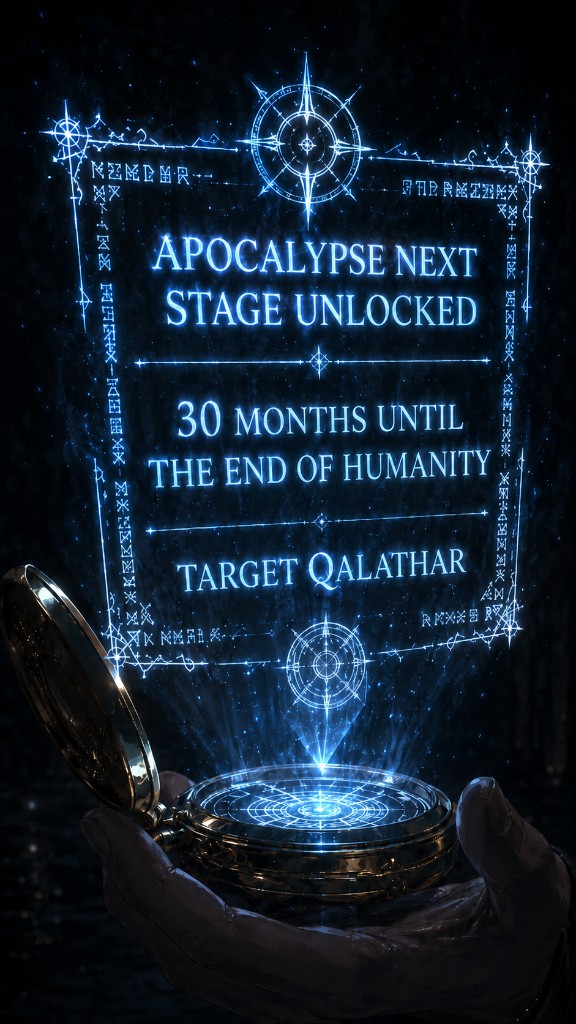
The pocket watch was already in my hand. I hadn't consciously reached for it. The grimoire materialized between my fingers.
The display bloomed.