At the Iron Cross Formation School. First morning.
The only indication that the building served any purpose beyond filing municipal tax records was the Iron Cross emblem carved into the lintel above the door.
Inside was different.
The entrance hall swallowed the quiet of the street and replaced it with the particular hum of an institution operating at capacity. Bodies moved through the corridors with the hurried purpose of people who carried too many tasks and not enough hours. Clerks with armloads of paper navigated between desks. Communication crystals buzzed from every surface. Somewhere deeper in the building, a door slammed with the percussive finality of a conversation that had ended badly.
This was the heart of the Iron Cross. A machine built from paper, people, and the processing of information.
Perhaps the only difference from a common administrative building was that they all carried swords.
Different sizes, different positions, but none of them seemed to have magic, rods, or wands.
The clerk who processed my arrival didn't look up from her ledger when she spoke.
"Name."
"Kaspar von Hexenzeit."
A beat. Her quill paused. Her eyes lifted by exactly the distance required to confirm the face attached to the name, then returned to the page.
"Third floor. Room 312. Orientation begins at the seventh bell."
No fanfare or indication that the Hero of Grenzheim got a treatment different from any other candidate.
I liked that.
The classroom phase lasted two months before the real work began.
The Formation School's curriculum operated on a principle I recognized from my previous life, though the context was radically different. Back then, the closest analogue had been the fire academy. We had weeks of classroom instruction compressed into a format that prioritized practical application over theoretical elegance. You learned the science because the science kept you alive, not because anyone expected you to publish a paper on combustion dynamics.
Here, the science was mana. The combustion was magical. And the things that could kill you operated on principles that no firefighter's manual had ever anticipated.
The twelve candidates had been divided on the first day. Six to Investigation. Three to War. Three to Patrol. The division happened without ceremony. A Knight-Commander read names from a list, pointed at doors, and the groups separated. I caught a brief glimpse of the War candidates disappearing down a stairwell toward what I assumed were the training halls. The Patrol candidates went the opposite direction.
I never saw them during class hours after that.
Investigation occupied the building's third floor. Three classrooms, a small library, and an office that the instructors shared through an arrangement that seemed to generate more territorial disputes than the southern front.
The six of us filled the desks each morning and submitted to a curriculum that tried to compress several years of specialized education into two months.
Mana trace analysis came first.
The instructor was a retired Magical Army officer named Drescher whose left hand was a prosthetic of articulated bronze, a replacement for the original he'd lost to an elven spell twenty years prior. The prosthetic clicked and whirred when he gestured, which was constantly.
"Every spell leaves a signature," Drescher said on the first morning. He stood at the front of the classroom with a crystal vial in his bronze hand, holding it up to the mana-glow strip so the contents caught the light. Inside the vial, a faint residue clung to the glass, a film of iridescent material so thin it was barely visible.
"When a mage casts, the mana that flows through their circles carries markers. Frequency and amplitude. Harmonic structure. These markers are as unique as a fingerprint and considerably more difficult to forge."
He set the vial on the desk.
"Your job, when you find a crime scene where magic was used, is to read those markers. Identify the spell type and the caster's circle formation. Build a signature that can be matched against known individuals."
Drescher tapped the vial with his bronze finger.
"Now. Some of you are thinking you can't read mana without Circles, and that this lecture is theoretical."
His eyes swept the six of us. Lingered on each face long enough to confirm that yes, that was exactly what some of us were thinking.
"You're wrong."
He set the vial down and raised the bronze hand. The articulated fingers spread wide, each segment rotating with a faint mechanical whir.
"Every one of you practices Mana Blood. Some of you practice Mana Breath. You've spent years channeling mana through your own tissue. It moves, it burns, and it keeps muscle working past failure."
He lowered the hand.
"That sustained contact changes you. Circles are architecture, formal structures that organize mana into patterns a caster can direct outward. What you have is cruder. In certain respects, more intimate."
He picked up the vial again. Held it at arm's length.
"A mage matches residue to a framework they've been taught. You feel it directly, the way you already feel mana in your blood."
The prosthetic finger tapped the glass.
"In mana trace analysis, that sensitivity is an asset. A mage examining a crime scene will identify the spell type and the circle formation through theoretical pattern-matching. Effective, but slow. Limited by the frameworks they've been taught."
He set the vial on the desk again.
"You won't have those frameworks. What you'll have, if your training has been worth anything, is the ability to feel the residue directly. To sense the harmonic structure without needing to decompose it into its theoretical components first."
He pointed at us with the bronze index finger.
"Some of you will be adequate. A rare few will read traces a mage would need an hour to identify."
His eyes found mine for a second.
"Let's find out which category you fall into."
The practical exercises began that afternoon.
Drescher had prepared a series of test stations along the third-floor corridor. Each station was a warded stone box the size of a bread loaf, plus a notation card to fill in after examination.
Place your hands on the box. Feel what's inside. Write down type, intensity, harmonic structure, and any anomalies.
The first box took me eleven seconds.
I placed my palms flat against the cool stone. Closed my eyes. Let the perception that months of Mana Breath had cultivated expand outward through my fingertips and into the warded surface.
The ward itself was the first thing I felt. A thin membrane of structured mana that clung to the stone's interior like a skin. Cold. Rigid. Designed to contain rather than repel.
Beneath the ward, the residue.
It hit my perception like a scent hits a bloodhound. A distinct, layered signal that separated itself into components the moment I focused on it.
Fire-aspected. Third Circle intensity. The harmonic structure was clean, regular oscillations with minimal decay, recent work by someone with control. A slight flutter in the lower frequencies marked a hesitation at release.
I opened my eyes. Wrote it down.
Moved to the next box.
This one was different. The residue was older. The harmonics had degraded, their edges blurring into the ambient noise the way a footprint blurs in rain. But the core signature was still there. Earth-aspected. Second Circle. The flutter was absent. This caster had been decisive, the release clean.
Thirty-eight seconds.
I moved down the line. Box after box. Each one holding a different signature, a different puzzle. Some were layered, multiple spells cast in sequence, their residues overlapping. Those took longer. I had to separate the signals, peel them apart, feeling for the boundaries where one ended and the next began.
I finished the twelve stations before any of the other five candidates had completed their sixth.
Drescher appeared at my shoulder. His bronze hand reached for my notation cards. He flipped through them. His expression didn't change during the first three. By the fourth, his eyebrows had risen. By the eighth, his eyebrows had climbed.
He stopped at the tenth card.
"The hesitation flutter," he said. He held the card up. His eyes moved from the notation to me and back. "You identified a casting hesitation from residue analysis."
"It was in the lower frequencies," I said. "A disruption in the harmonic decay pattern. Subtle, but consistent with a momentary interruption in the caster's intent."
Drescher stared at me.
"That detail," he said slowly, "was included in the exercise as a control variable. It's not something the candidates are expected to detect. It's something I embedded to verify that the test chambers were properly calibrated."
He set the card on the desk.
"In twelve years of running this exercise, two people have identified it." His bronze finger tapped the card twice. "Both of them were Magical Army analysts with four Circles and a decade of field experience."
He looked at me.
"Noted," he said.
The notification appeared at the edge of my vision as I returned to my desk. I dismissed it with a thought.
The other candidates were still working through the stations. I watched them from my seat. Their hands pressed against the stone boxes with the concentrated intensity of people straining to hear a whisper through a wall.
Henrik, the former Patrol Division operative, worked with patience, his notations careful and methodical. Lena, the logistics specialist, struggled with the harmonic analysis but compensated with an analytical precision that extracted usable data from faint signatures.
Details that registered in my perception as clearly as color arrived in theirs as vague impressions that took minutes to parse.
Nine cores.
That was the difference. Nine mana cores feeding a respiratory system that had been channeling mana for months without interruption. The sheer volume of mana that flowed through my tissue at any given moment had refined my perception into something that Drescher's curriculum hadn't been designed to accommodate.
When the other candidates asked how I'd finished so quickly, I kept it short.
"Practice," I said. "Lots of practice."
Spell assembly analysis came next.
Trace analysis dealt with residue after a spell had been cast. Assembly analysis concerned itself with how spells were constructed, and why the difference between a First Circle ward and a Third Circle offensive matrix mattered in a room where someone had been killed by one of them.
The instructor for this module was a woman named Falk whose robes bore the insignia of the Academy's theoretical faculty. She had the bearing of someone who had spent decades in lecture halls and treated fieldwork as a necessary evil.
"A spell," Falk said on her first morning, chalk in hand, a blackboard floating at her shoulder, "is a sequence of operations executed in a specific order at a specific speed. Understanding that sequence is the difference between knowing what happened and knowing how it happened."
She drew a diagram. The chalk moved in precise, economical strokes that produced a schematic of interlocking circles and connecting lines.
"When you encounter an assault, a sabotage, or a ward breach, the spell tells you more than any witness. Type and efficiency give you training and experience."
She tapped the diagram.
"A soldier casts differently than an assassin. Each tradition carries structural signatures as distinctive as an accent."
The material was dense. Theoretical in a way that the trace analysis hadn't been. Drescher's lessons were hands on stone. Falk's were pattern recognition, looking at aftermath and reverse-engineering the process.
I struggled with the frameworks.
The memories Gluttony had released contained Kaspar's self-taught magical theory, in some areas past the Academy curriculum. Accessing it required knowing what to reach for.
Each lecture opened new possibilities. Falk would mention a concept, harmonic resonance in multi-circle casting, and the term would trigger a cascade of associated memories. Books detaching from shelves, their contents flooding in, filling the gaps in my understanding with information that the original Kaspar had accumulated through years of independent study.
The result was uneven. In some areas I leapt ahead of the curriculum, connecting theoretical dots that Falk hadn't drawn yet. In others I stumbled over basics that the other candidates grasped immediately.
I learned to manage the unevenness. When a gap appeared, I noted it. Returned to it during the evening hours in my quarters, searching the archive deliberately, walking corridors I hadn't explored, pulling books from shelves I hadn't visited.
Slowly, the index filled itself in.
Alchemy was different.
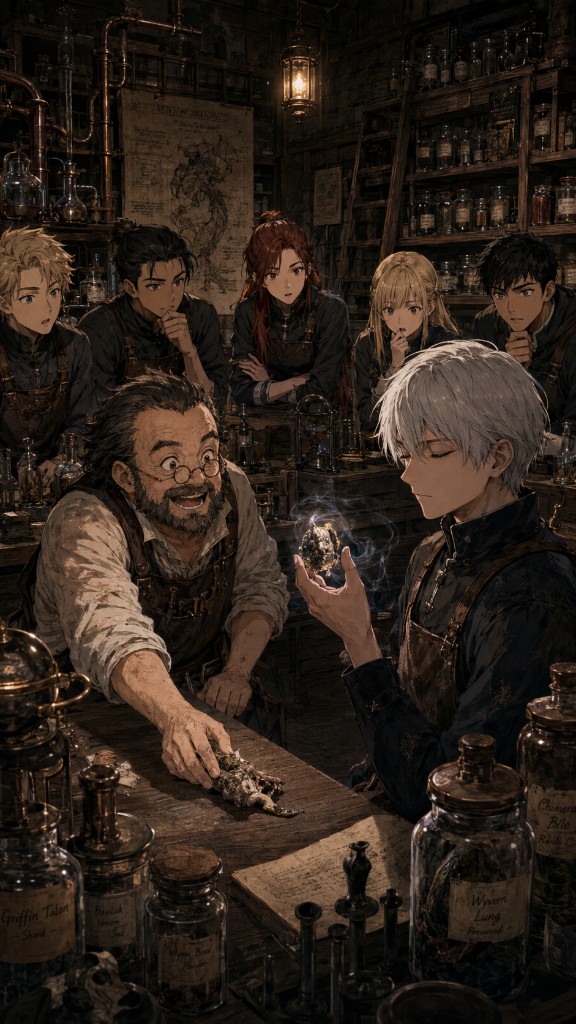
The instructor was a compact man named Thiel whose workshop occupied a converted storage room on the third floor's eastern end. Every surface was covered with apparatus. Glass vessels, copper tubing, ceramic crucibles, scales, and racks of labeled containers, some of them glowing faintly in the dark.
"Alchemy," Thiel said on the first morning, his sleeves rolled to the elbows and his hands already stained with something that might have been reagent residue or might have been breakfast.
He picked up a container from the nearest shelf. The label read Ironhide Boar. Liver Extract, Concentrated.
"The old definition, the transmutation of base materials into higher forms through the application of chemical principles, died about two centuries ago. What killed it was the recognition that mana integrates with biological systems. Monster tissue has been restructured by it."
He set the container down. Picked up another. Stormclaw Eagle. Adrenal Gland, Desiccated.
"Modern alchemy is biochemistry. It's the study of how mana-saturated biological compounds interact with human physiology. Monster cores, organs, glandular secretions, bone marrow. These materials contain mana in forms that resist conventional extraction. The mana isn't in the tissue. The mana is the tissue."
He waved the container at us.
"Your job, when you encounter a poison, a performance enhancer, or a drug, is to identify its origin, how it was prepared, and what it does to the body."
He set the container down and grinned. The expression was the particular enthusiasm of a man who loved his subject with a passion that bordered on the romantic.
"Let's start with something simple. Who can tell me what happens when you ingest powdered monster core?"
The question landed in silence.
My hand rose before the thought had fully formed.
The answer came from the library. A book that had been sitting on the nearest shelf, waiting for exactly this question. Kaspar's voice, precise and clinical, echoing through the memory of a hundred late nights spent studying the interaction between ingested core material and human digestive enzymes.
"The core material dissolves in gastric acid," I said. "The mana bound within the crystalline matrix is released into the digestive tract. In a mage with active Circles, the released mana is absorbed into the existing channel network and processed as ambient intake. It acts as a temporary boost with minimal side effects. In a subject without Circles, the mana has no place to follow. It disperses into the surrounding tissue, producing localized cellular stimulation that mimics core activation without establishing permanent pathways."
I paused.
"The stimulation is temporary. When the compound is metabolized, the effect ceases. Repeated exposure without established channels produces progressive degradation of the tissue interfaces. The cells that absorbed the unstructured mana develop micro-damage that accumulates over time."
The classroom was quiet.
Thiel was staring at me.
"That," he said slowly, "is a fourth-year Academy answer. From the advanced biochemical alchemy track. Which I happen to know you never took, since I'm the only professor."
I held his gaze.
"I read a lot," I said.
Thiel's stare held for three more seconds. Then the grin returned, wider than before.
"Good," he said. "Then you can help me with the demonstrations."
The levels came fast. Three in the first week alone.
The theoretical understanding that Kaspar's memories provided was a foundation, but the levels didn't climb until I applied that understanding. Until my hands mixed compounds, until my perception evaluated the mana content of biological materials, until the abstract formulas became physical actions with measurable results.
Kaspar's hands had known these motions. Mine were learning them fresh. But the mind behind the hands knew what each motion was supposed to accomplish, and that foreknowledge compressed the learning curve from months into days.
By the second week, Thiel had stopped pretending I was a normal student and started using me as a teaching aid.
"Von Hexenzeit," he'd say, sliding a sample across the workbench. "Identify."
I'd pick it up. Close my eyes. Let the mana perception do its work. I felt the compound's internal structure, how the components had been processed, the residual signatures of origin and method.
"Frostfang serpent venom," I'd say. "Reduced in ethanol. The reduction was incomplete. There's still active enzymatic material in the lower fraction. If this was intended as a paralytic agent, the dosing would be unpredictable. Too much active enzyme in one batch, too little in the next."
Thiel would nod. Turn to the rest of the class.
"This is why consistency matters in preparation. A poorly reduced compound doesn't just fail, it fails differently every time. And in an investigation, that inconsistency is a signature. It tells you about the alchemist who made it. Their skill level, equipment, and patience."
The other candidates accepted my role without visible resentment. Henrik, in particular, seemed to appreciate having someone in the class who could explain the material in terms that didn't require Thiel's tendency toward tangential enthusiasm.
Lena took notes with a speed and precision that suggested she was building her own reference library in real time. More than once I caught her watching my hands during the practical exercises.
And then there was the subject that made my skull ache.
"Blood washes out. Magic fades. But gold? They never let go of the gold. Learn to read where the coin flows, and you'll always find your mark."
That was the only introduction he gave before the first lesson on Financial Forensics.