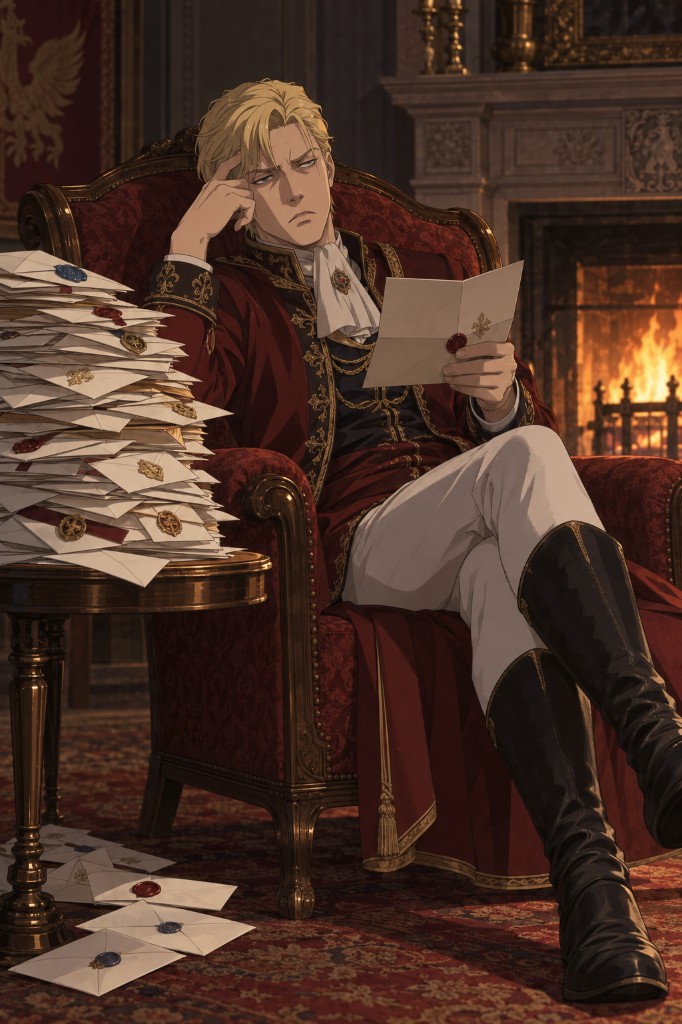
Silberwald. A private room behind the Hall of Deliberation.
Lord Gregor von Westrich had many defects, and he was honest enough to keep a list of them.
He was a coward. He had never denied it. A man who owned four grain mills and two river crossings had no business standing near anything sharp.
He was greedy. He considered this a virtue that other people had mislabeled.
He was cruel, occasionally, when cruelty was cheaper than the alternative.
But Gregor von Westrich had never once been stupid.
It was the only quality he had inherited from his father that he intended to pass on, and it was the reason he was sitting at the end of the long table with his mouth shut while eleven other men shouted over one another.
The newspaper lay in the middle of the table where someone had thrown it an hour ago.
THE GREATEST ATTACK OF THE CENTURY.
Beneath the headline, a grainy reproduction of soldiers hauling copper plate across a slope that had belonged to the elves that morning. One of them had a shovel over his shoulder. The Chronicle had helpfully labeled the wrecked machine behind them an armored Grenzwacht magi-car.
The Hall had split within a day of the paper hitting the streets.
Elara's people had done what Elara's people did. They had risen in the gallery, one after another, and demanded to know by what authority the Iron Cross had launched an offensive without informing the Parlament or the Ministry of War. Cräusen had spoken for eleven minutes about unsanctioned aggression and the diplomatic consequences of provocation.
It had accomplished nothing.
Gregor had read the charter. The Iron Cross answered to the Crown and to no one else. Prince Varen commanded the Iron Cross. Every result and every consequence of that ridge belonged to Varen alone, for good or ill, and there was not a clause in the Empire's law that let the Hall take that away from him.
Kasimir's supporters had been quieter.
That was worse.
Gregor had watched the faces along his own bench while Cräusen thundered. Ten years, House Hexenzeit had promised. Ten years for a machine that did not exist yet, to compute a spell that had never been completed, to end a war by pushing the Sins back through doors no living person had seen.
None of them had been prepared for someone to offer something now.
A single ridge was a small thing measured against the whole war. But it was real, and it was printed on the front page of every paper in the capital, and a small victory a man could point at weighed more in the gallery than a great one he would have to wait ten years to see.
The dance had begun before the session closed.
It always looked the same. Men who had stood beside Kasimir's officers for six years discovered urgent business elsewhere in the gallery. Lesser lords who had never once received a greeting from Varen's staff began drifting toward the western doors, where Captain Falke stood with his hands behind his back and his expression carefully vacant.
Gregor had stayed in his seat.
He had stayed because he knew exactly how the story ended for every one of those men.
Varen did not appreciate turncoats. Varen did not forgive them, forget them, or feed them. The prince would accept their bows and their letters and their sudden enthusiasm, and he would give them nothing, and in three years when the succession was decided, they would discover that they had spent their only coin on a man who had never intended to extend a hand to them.
There were no crumbs at Varen's table for men who had left another table to get there.
"Simply resubmit our position," Baron Auerlicht was saying. His voice had climbed to the pitch it reached whenever he was frightened. "A statement of shared purpose. Nothing that contradicts His Highness Kasimir's program, merely an acknowledgment that the Iron Cross has—"
"Has what?" Lord Reissner leaned across the table. "Made Roderich look like a man selling a bridge he hasn't built?"
"I did not say that."
"You didn't need to. The Chronicle said it for you."
"The Chronicle also said the Bastard Knight lost an arm," someone put in from the far end. "That doesn't sound like a program I want to join."
"He lost an arm and took a ridge. How many arms has the Ministry lost this year? How many ridges have we won?"
"That is not—"
Gregor drummed his fingers on the table.
Four beats. Pause. Four beats.
Think.
There had to be an angle that didn't require walking to the western doors with his hat in his hand.
Beside him, Lord Gerold von Esslinger had gone a deep radish color. His coat had been buttoned incorrectly again, so that one side sat a finger's width higher than the other. He was mopping his forehead with a handkerchief and staring at the newspaper as though it had personally insulted his mother.
"The one who came out of this best," Esslinger said, to no one in particular, "is Dravenmoor." He dabbed at his temple. "They always make it look so much easier than it is."
Gregor's fingers stopped.
"How?"
Esslinger looked at him.
"The Comptroller is one of Kasimir's." Gregor turned in his chair. "She was in the gallery when Cräusen spoke. She didn't so much as look at the western doors. How has House Dravenmoor benefited from any of this?"
"Not the sister."
Esslinger folded his handkerchief.
"The brother."
Gregor searched his memory.
There was a brother. He had a vague impression of him.
"The younger one?"
"Darius." Esslinger nodded. "He's been the Bastard Knight's man since before there was a Bastard Knight."
The table had gone quieter. Two of the other arguments had stopped to listen.
"Explain that," Gregor said.
Esslinger seemed pleased to have the room.
"They were at the Academy together. Same year. When Hexenzeit came back from the Sultanate and the Crown put him on trial. You remember the trial."
"Everyone remembers the trial."
"Then you remember what happened afterward. In the corridor. Hexenzeit walked out of the Forum acquitted and the first person he went to was Darius von Dravenmoor. In front of forty journalists. Took the boy by the robe and thanked him." Esslinger spread his hands. "The Morning Bell ran the sketch."
"Thanked him for what?"
"Nobody knows. That's rather the point."
Gregor sat back.
"So a student was seen with a Knight once."
"Once?" Lord Reissner had abandoned his argument entirely. "You didn't hear about the symposium?"
Gregor had not heard about the symposium.
"Year's end. Hexenzeit had been back in the capital less than a week. Nobody had seen him near the Academy since his fall. Then he turns up in the amphitheater. Who walks him in?" Reissner tapped the table. "Dravenmoor. Personally. Sat him down in the middle tier and left him there."
"So what?"
"So what? It was there that he found Mercer."
Rolf Mercer. Cooling glyphs. The device that made Kaspar rich and powerful.
Gregor looked at the newspaper.
"Then the boy must be a political genius," Gregor said.
Nobody laughed.
"Think about it," he went on, and his voice had found the register he used for grain contracts. "Kaspar von Hexenzeit had no Circles and no family. A fourth-year student looked at that man and saw this." He put his finger on the photograph. "Before any of us."
"He has been at the Academy a long time. He must have been gathering connections," Baron Auerlicht offered. "A man does not remain that long unless he is clever. I have seen him give presentations."
"You have?"
"Department of Imperial History. He speaks well."
"And he never took Varen's side," Gregor said. "House Dravenmoor has a direct line to the man who moved the front, and they got it without changing benches once."
The room had gone entirely quiet now.
Gregor brought his palm down on the table.
The sound made Auerlicht jump.
"Then I know how we use the moment."
Eleven faces turned toward him.
"Darius von Dravenmoor holds no seat in this Hall," Gregor said. "He is twenty. His house has one voice in the gallery and it belongs to his sister. The elections for the lesser benches are in five weeks." He let that sit. "Five weeks is enough time to make a young man a candidate. Let's secure the endorsements and see him seated before the summer recess."
"Under Kasimir's bloc," Reissner said.
"Under ours." Gregor leaned forward. "He owes us his seat. And when he takes his chair on this bench, he brings his connection with him, and not one of us has to walk to Varen to get it."
Esslinger's radish color had begun to fade toward something like health.
"Hexenzeit would see the boy as one of his own," he said. "Elected by Kasimir's people."
"Hexenzeit would see that Kasimir's people recognized a genius before Varen did." Gregor smiled. "Let the prince explain to his cousin why we noticed and he didn't."
"And Kasimir?"
"Gains a bench that hasn't emptied."
A pause.
Then Reissner laughed, once, and pulled the newspaper toward himself.
"Five weeks."
Auerlicht was already reaching for pen and paper. Two other lords had begun a quiet argument over which of them would extend the first dinner invitation. Esslinger was buttoning his coat correctly for what Gregor suspected was the first time that month.
Gregor leaned back in his chair and let the smile stay.
This was why he sat where he sat.
The Dravenmoor townhouse.
Sera von Dravenmoor was reviewing the harbor customs ledger when her brother came into the study without knocking.
He had a stack of letters in one hand.
He dropped them on her desk.
"Good afternoon, Darius."
"Why does everyone want to have dinner with me?"
Sera set down her pen.
Behind her, Elsa paused in the act of drawing the curtain and did not finish.
"I beg your pardon."
"Dinner." Darius gestured at the letters as though they might explain themselves. "That one came this morning. Those four came yesterday. The one with the vine-leaf seal came twice, the second time by hand, and the man who brought it stood in the hall for ten minutes as if he expected me to come down and thank him."
Sera turned the nearest envelope over.
Esslinger.
She turned over the next. Reissner. The next. Auerlicht.
"I don't even know these people," Darius said. "I couldn't pick half of them out of a crowd. Provincial lords with mills and river tolls and nothing interesting to say about any of it."
He dropped into the chair across from her desk and let his head fall back against it.
"I have no interest in eating overcooked pheasant while some baron tells me about his grain yields. I haven't had a single quiet evening since the trial. All I want is to sit by a fire and read a good book that nobody wrote to flatter anyone. Is that really so much to ask?"