Republic of Wolkenmark.
The snow had been falling for three hours.
Lena crouched beside the stone wall that bordered the property's southern approach and studied the farmhouse through the white curtain. Two stories. Timber frame on a stone foundation, the kind of construction that dotted the Republic's eastern provinces in clusters of three or four.
No light in the windows.
No smoke from the chimney.
The snow lay undisturbed on the path from the road to the front door. No footprints. No wheel tracks. No indication that anyone had entered or left in the hours since the last accumulation had begun.
Henrik emerged from the tree line to her left. He moved well for a man carrying a greatsword. The Formation School had filed the roughest edges off his impatience.
He reached the wall and dropped into a crouch beside her. His breath came in thin clouds.
"Back door's boarded from outside," he said, low. "Nails driven through the frame. Recent. The wood's not weathered."
Someone had sealed the rear exit. That was either fortification or containment, and neither interpretation was comfortable.
She drew the leaf-blade sword from its sheath. The steel came free without a sound. She'd oiled the leather that morning.
Eight months.
The trail from the empty Auricht estate in Silberwald to a country house outside the capital. From the country house to a coaching inn on the northern trade road. From the inn to a border crossing into the Republic. From the border to a network of safe houses that wound through the Republic's eastern provinces like thread through a needle, each connection thinner than the last.
And finally, here. A farmhouse in the snow, three days' ride from the nearest town.
Henrik nodded.
They crossed the yard.
Nobody shot at them.
Lena reached the door first. She crouched beside the frame and laid her left hand flat against the iron latch.
Cold. No trace of a hand that had touched it recently. No indication that the door had been opened since the snow began.
She looked at Henrik.
He stood two paces back. His right hand rested on the hilt of the short sword at his belt.
He met her eyes. Nodded once.
Lena pressed the latch. The mechanism yielded. She eased the door inward. The hinges gave a single low groan that the falling snow absorbed before it could carry.
The smell reached her before her eyes adjusted.
Copper and something fainter beneath it.
Lena raised the leaf-blade and stepped through.
The entrance hall was narrow. Timber walls, plaster between the beams, a row of iron hooks on the left for coats and cloaks. Three coats hung from them. A woman's traveling cloak, heavy wool with a fur-lined collar. A man's overcoat, dark, well-made. A smaller coat. A girl's.
Lena's eyes tracked across them without stopping.
She moved down the hall. Henrik followed, his short sword drawn, each footfall placed on the boards she'd already tested.
The living room opened at the hall's end.
The cold inside was absolute. The same temperature as the air beyond the walls. The reason was visible immediately: a window on the eastern wall stood open, its shutters thrown wide, snow accumulating on the sill and spilling onto the floorboards.
Nobody had closed it.
Lena stopped.
Three figures sat at the kitchen table.
They were arranged as though for a meal. Someone had placed them. Someone had sat them upright, adjusted the angle of their spines against the chair backs, positioned their hands on the table's surface.
The man on the left was Lord Auricht.
His eyes were gone.
The sockets were clean. Removed with a blade thin enough and steady enough to excise the orbital contents without damaging the surrounding bone.
His tongue had been cut. The mouth hung slightly open, and through the gap between the lips the severed root was visible, dark against the pale interior.
The woman beside him — Lady Auricht, presumably — sat in the same pose. Hands flat. Spine against the chair. The same empty sockets. The same opened mouth, the same severed tongue.
The girl was younger than Lena had expected. Twelve, perhaps. Thirteen at most. Her hair was dark and had been brushed. Someone had brushed her hair after killing her, or before.
The same mutilation.
All three facing the open window, as though they'd been arranged to look out at the snow.
Henrik made a sound behind her.
Lena didn't turn.
She stood in the doorway and looked at the three figures. The cold pressed in.
She scanned the room.
No signs of forced entry. The front door had been unlocked. The rear door boarded from outside. Someone had sealed the exit, entered through the front, done the work, and left through the front again.
See nothing. Say nothing.
Between the three pairs of hands, gouged into the surface of the table with a blade, four words:
PEACE ABOVE HUMANS
Lena reached into her coat and withdrew the notebook. The leather cover was soft from months of handling. She opened it.
Three names.
Lena drew a single line through each name.
She closed the notebook.
"Henrik."
He was still standing in the doorway. His face was the color of the snow on the windowsill.
"We're leaving," she said.
His jaw worked. The tendons in his neck stood taut.
"We can't just—"
"We're operatives on foreign soil without diplomatic cover, standing over three murdered Imperial nationals." Lena sheathed the leaf-blade and crossed the room toward the hall. "Whoever did this chose Wolkenmark for a reason." She stopped at the doorway and looked at him.
Henrik's hand trembled on the hilt of the short sword. His eyes moved to the girl at the table.
"Fuck!" he said.
"I know," Lena said.
She did not look back at the house.
Hexenzeit.
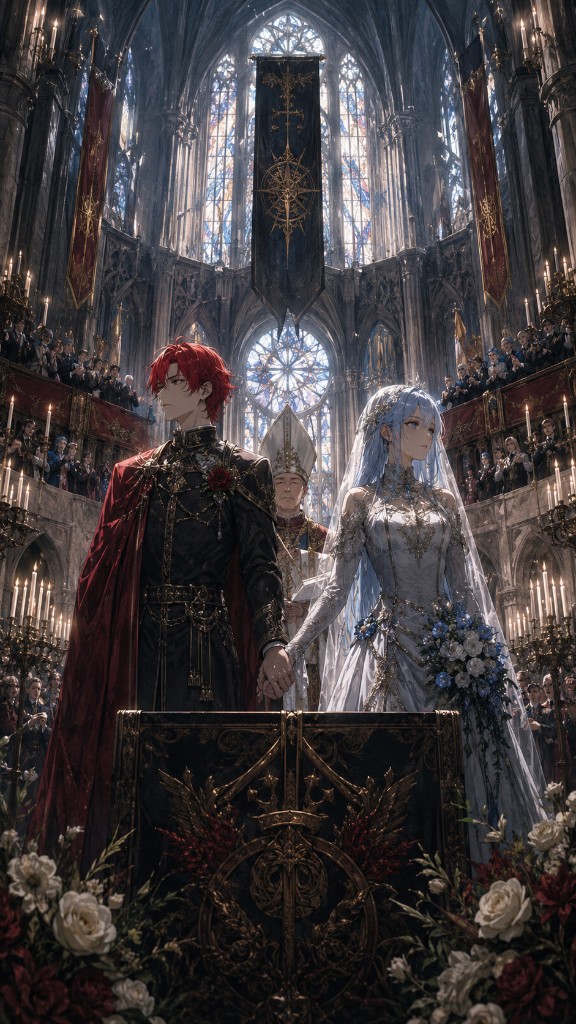
Professor Nikolai Orlov had attended too many state weddings across three decades of academic observation, and this was the strangest.
The ceremony itself was competent. The cathedral of Hexenzeit had been prepared as one expected from a house that had hosted dynastic rituals for generations. The flowers were appropriate. The candles were lit. The officiant spoke the words in the correct order, with the correct intonation, and committed no errors of protocol that would have given the assembled nobility something to whisper about during the reception.
The problem was the bride and groom.
Orlov sat in the fourth tier of the guests' gallery, a position that afforded an excellent view of the dais and a comfortable distance from the families' inner circles. He held a leather-bound notebook open on his knee and a pen poised above a page already dense with observations rendered in the compact Wolkenmark shorthand that no Imperial could read without years of formal study.
Hagen von Hexenzeit stood at the left of the dais. The heir was tall, sharp-featured, his hair the deep Hexenzeit crimson. His posture was perfect, his hands still — the expression of a man completing a transaction as the officiant guided him through the vows.
Not hostile. Not reluctant. Simply absent. A task that needed doing. A box that needed checking.
Beside him, Duchess Saskia von Winterkrone matched his detachment with her own.
She was striking. The ice-blue hair of the Winterkrone bloodline fell past her shoulders. Her features were sharp, intelligent, the face of a woman who had spent six years at the Academy's research frontier.
She spoke her vows to the officiant. Her eyes never found Hagen's. His never sought hers.
In a society where dynastic marriages were the currency of political survival, a certain coldness was expected. The bride and groom were not required to love each other. They were required to produce heirs, consolidate holdings, and present a unified front to the court. Affection was a luxury. Tolerance was sufficient.
But this was not tolerance.
This was two people standing shoulder to shoulder at the altar, both aware that neither had chosen this. That the hands they joined when the officiant directed them to do so were the hands of strangers bound by strategic necessity, and that the strategic necessity had been calculated by someone else entirely.
Orlov wrote: Neither hostile. Neither warm. The marriage of two instruments, not two people.
He paused. Added: The bride is too intelligent to resent it publicly. The groom is too disciplined. What they feel privately is irrelevant to everyone in this cathedral except, perhaps, to each other.
The ceremony concluded. The officiant blessed the union.
The assembled guests rose. Applause, measured and correct. No cheering. No thrown flowers. The wedding of Hexenzeit's heir was a political event attended by political animals, and they clapped the way political animals did: precisely enough to be polite, briefly enough to imply that the real business was elsewhere.
Orlov closed his notebook and tucked the pen into his coat.
He would not stay for the feast. His presence here was already an indulgence, a Wolkenmark academic attending an Imperial dynastic wedding under the thin cover of a diplomatic observer's credential that the Akademie der Arkanen had issued.
He descended from the gallery and made his way toward the cathedral's western exit, threading between clusters of guests who moved in the practiced formations of court society.
His path took him to the courtyard. Guards in the house livery flanked the doors, their eyes moving across the departing guests.
Orlov was two steps from the threshold when a voice caught him.
"Professor Orlov."
He turned.
The man who'd spoken was tall, broad through the shoulders, with a weathered face and graying temples. He wore a formal coat of dark wool over military boots. The crest on his breast was minor nobility. A border house, if Orlov placed it correctly. One of the families that held the mountain passes between Hexenzeit's territory and the Republic's southern frontier.
"Lord Meierhof," Orlov said.
Meierhof extended his hand. The grip was firm, dry.
"I wasn't sure you'd come this far south," Meierhof said. "The Akademie doesn't usually send observers to weddings."
"The Akademie sends observers wherever the political landscape shifts." Orlov adjusted the notebook under his arm. "And this particular shift has implications for the Republic's southern border arrangements."
"The Winterkrone-Hexenzeit alignment."
"Precisely. The marriage consolidates the north. It secures Prince Kasimir's strongest ally and removes any possibility of Winterkrone drifting toward the Elara bloc." Orlov paused. "From Wolkenmark's perspective, a unified northern Empire is a stable neighbor. Stability is preferable to the alternative."
Meierhof grunted. "The alternative being the Empire tearing itself apart over the succession while the rest of us deal with the consequences."
"As always."
Meierhof was a border lord. His holdings sat on the seam between the Empire and the Republic. He understood Wolkenmark's concerns because they were, in large part, his own.
"How are the straits?" Meierhof asked, lower.
Orlov's expression didn't change. "The Vrakh mounted three raids in the last season. Two probes along the eastern shore. One full-scale landing attempt." He met Meierhof's eyes. "The Akademie published the casualties at forty-seven. The actual number is closer to two hundred."
Meierhof was quiet for a moment.
"The Empire has its elves," Meierhof said eventually. "You have your orcs."
"We have our orcs," Orlov agreed. "And fewer walls to hide behind."
That was the truth that underlay every interaction between the Republic and the Empire. Silberwald faced the elven advance from the south, a war fought along a defined front with established fortifications and a military apparatus that, for all its dysfunction, fielded hundreds of thousands of soldiers. Wolkenmark faced the Vrakh across the northern strait, a body of water narrow enough that the orc war-barges could cross it in favorable weather, wide enough that no permanent fortification could seal it. Every raid that landed on the Republic's coast was a reminder that the sea was not a wall. It was a door that the orcs could open whenever they chose.
The Akademie der Arkanen existed, in part, because the Republic could not afford to fight the way the Empire fought. They could not match Silberwald's numbers. They could not replicate the Magic Academy's pipeline of trained combat mages. What they could do was think, and hope that thinking, applied with sufficient rigor, would produce solutions that brute force could not.
It was, Orlov reflected, a strategy that required a great deal of faith in the power of intelligence over the power of muscle. Some days he believed in it. Some days he didn't.
Meierhof shifted his weight and glanced toward the courtyard. Something had caught his attention.
"Speaking of uncomfortable neighbors," the border lord said.
Orlov followed his gaze.
A delegation was crossing the courtyard from the guest quarters toward the cathedral. Four men in coats of pale leather and brushed wool, their cut and fabric unmistakably foreign. The garments were expensive in the particular way that announced wealth without taste.
The double wave sigil.
Goldfield.
Orlov's stomach turned.
The Principality of Goldfield occupied a former offshore extraction platform. One of the old world's colossal deep-sea rigs. It was one of the few pre-portal structures never destroyed by Titans, its isolation in the water and the sheer mass of its industrial foundations having either discouraged Titans or simply gone unnoticed. The current occupants had expanded the platform over generations, bolting habitation modules and workshop levels onto the original superstructure until the rig had become a vertical city of salt-crusted concrete, its lower decks submerged, its upper tiers rising above the waves.
Its prince was, by most credible accounts, one of the most powerful living mages on the continent. A Seventh Circle Mage whose abilities had been verified by sources Orlov trusted and disputed by sources Orlov also trusted, which meant the truth was probably worse than either estimate.
The man had no scruples. The word implied a capacity for moral reasoning that the Prince of Goldfield had either never possessed or had discarded completely.
He traded with everyone.
Orc, elf, or human. The Prince of Goldfield served no cause but commerce, and commerce had no enemies, only customers.
Orlov turned on his heel before the delegation could close to conversational distance. He tucked the notebook tighter under his arm, dropped his chin, and walked briskly toward the cathedral's western gate.
Meierhof watched him go. The border lord's mouth twitched.
Orlov spat on the ground and kept walking.