"Some of it," I said.
Behind Marco, his wife had pulled the two girls to their feet. The older one had stopped crying, but her face was blotchy and red, her eyes fixed on the bodies on the floor. The younger one kept her face buried in her mother's hip and wouldn't look at anything at all.
"We were eating breakfast," Marco said. "Helena was cutting the girls' food. And we heard screaming and explosions."
He paused and swallowed.
"I went to the door. Looked through the peephole. Hallway was empty. I opened it, I saw the blue light." He gestured vaguely at the air. "It told me to pick a class. Gave me a timer."
"What class?"
"Shield Bearer." He said it without hesitation. "I picked it, but didn't read the description. Didn't think too much about it."
Shield Bearer. Tank-adjacent defensive class. Focused on damage mitigation and protection auras. Solid pick for someone who plays with others.
"The screen disappeared," Marco continued. "And then I heard them in the stairwell."
He looked at the hammer in his hand as if seeing it for the first time.
"I got most of them. But the last two pushed past me." His jaw tightened.
I nodded. Said nothing for a moment.
"What about you?" Marco asked. "You seem like you know what you're doing."
Careful.
The instinct flared. The part of me that had spent two thousand hours in competitive lobbies learning the value of information asymmetry.
In Z Royal Defense, knowledge was the most powerful currency in the game.
Knowing wave compositions before they spawned. Knowing which reward picks scaled and which ones were traps. Knowing the hidden interactions between class skills and defensive structures. The players who dominated the leaderboard weren't the ones with the fastest reflexes. They were the ones who understood the system better than everyone else.
If I told Marco too much, I might draw too much attention. And not just him. Anyone he told. Anyone they told. And eventually, someone in that chain would be smarter than me, or more ruthless than me, or both.
But there was another side to that coin. People who saw you as knowledgeable, as someone who understood how this worked, they gravitated toward you. They followed. They protected the person who could tell them what was coming. In the game's competitive scene, the best guild leaders weren't always the highest-level players. They were the ones who could read the system and explain it clearly enough that everyone around them played better. Information was leverage, yes. But leverage only worked if someone was on the other end of it, pulling with you.
If I play this too close to the chest, I'm alone with a kitchen knife. If I share just enough, I'm the guy people want standing next to them.
I needed to find the line. Give enough to build trust. Keep enough to stay ahead.
"I was asleep," I said. "Woke up and the power was out. Just like you, when I opened my door, the blue screen popped up. Picked a class, fought them, and started moving floor to floor trying to understand what was happening."
All true. Nothing that gave away the depth of what I knew.
"I figured staying in one place was a bad idea," I added. "If more of those things are coming, I'd rather know the building's layout than get surprised."
Marco studied me for a long beat. Then he nodded.
"Marco." His wife's voice was soft but firm. She stepped forward. "We should introduce ourselves properly."
She had dark eyes, a strong face, the kind of composure that took effort to maintain.
"Helena," she said. "This is Lucy." She touched the older girl's head. "And Sophie." A gentle hand on the smaller one.
Lucy looked up at me with wide, dark eyes. She said nothing.
Sophie didn't look up at all.
"Scott," I said. "I'm on the fifteenth floor."
"Well, Scott from the fifteenth floor," Helena said. "Thank you. For what you did."
I nodded.
"You should arm yourselves," I said. "Even them. Something small. A screwdriver, a letter opener. Something they can jab with if something gets close."
Helena's face went tight. Her hand tightened on Lucy's shoulder.
"They're children," she said.
"I know." I didn't soften it. "But those things don't care. If something gets past you and Marco, and the girls have nothing, that's their end. If they have something sharp and they stab upward into the eye or the mouth."
The silence that followed was heavy. Marco looked at his wife. She looked back at him. That wordless communication again.
Helena closed her eyes. Opened them.
"Lucy, go to Daddy's toolbox. Bring me the two screwdrivers. The ones with the yellow handles."
Lucy hesitated. Then she moved, stepping carefully around the edge of the living room, avoiding the bodies, her small sneakers leaving prints in the drying black fluid. She disappeared into the kitchen.
I looked toward the front door.
"I'm going to keep moving," I said. "Down to the lobby. See who's left."
Marco's brow furrowed. "You sure about that? You've got a kitchen knife, Scott."
"I know." I adjusted the stockpot. "But I can't sit in a room and wait. That's not going to work for me."
Marco was quiet for a second. Then he turned back toward the apartment.
"Helena."
She looked at him. He didn't need to say anything else. That wordless thing again. She read his face and something tightened around her mouth, but she didn't argue.
"I'm coming with you," Marco said. He hefted the hammer, rolled his shoulder. "My family's barricaded. The girls have Helena. But I need to know what's down there. I need to know what we're dealing with, for them." He glanced back at the apartment one last time. "Sitting up here blind is just a slower way to die."
I studied him. The man had just fought off a wave with a claw hammer and bare desperation. He was running on fumes and adrenaline and the primal terror of a father who'd almost watched his children get eaten. He wasn't trained. He wasn't a gamer. He wasn't operating on two thousand hours of pattern recognition.
But he was big, he was angry, and he had a hammer. And two bodies was better than one in a stairwell.
"Alright," I said.
Helena pulled Marco into a fierce, brief embrace. She whispered something into his ear that I couldn't hear. He kissed the top of her head, then each of the girls, one hand cupping the back of Sophie's skull with the kind of gentleness that looked impossible from hands that thick.
"Lock it behind me," he said. "The dresser, the bookshelf, all of it. Don't open for anyone but me or Scott."
Helena nodded once. Her eyes were dry. Whatever she was feeling, she'd packed it down somewhere deep, somewhere the girls couldn't see it.
Marco stepped into the hallway. Behind us, the heavy scrape of furniture being dragged across hardwood resumed. The click of the deadbolt engaging was the last sound from inside.
The hallway was empty.
Then a second box, brighter than the first, edged in a pale gold I hadn't seen before.
My breath caught.
Three options materialized, each framed in that pale gold light.
I stared at them.
Permanent augmentations. At wave one.
In Z Royal Defense, permanent stat boosts didn't appear in the reward pool until wave twenty at the absolute earliest, and even then only if you'd maintained a perfect no-breach streak. They were the rarest, most coveted drops in the game. The competitive community called them "foundation stones" because everything else you built sat on top of them.
Getting three options at wave one because I'd gone hunting in someone else's territory was—
Broken. This is broken. This is exactly why wave-stealing was the meta.
I read the options again.
Iron Constitution. Tempting. In a world where a single bite could mean death, survivability had obvious value. But Health scaling in the early game was a trap. At low levels, 15% of a small health pool was barely noticeable. The bleed reduction was nice but situational.
Structural Intuition. My class synergy screamed at me to take it. Intelligence boosted blueprint comprehension, which meant faster turret deployment, faster barricade construction, faster everything once I started unlocking real engineering skills.
But I kept coming back to B.
Sharpened Reflexes. Fifteen percent base Agility. Twenty percent faster reaction speed.
I'm an Engineer. My turret lasts sixty seconds. My cooldown is two minutes. That leaves sixty seconds of every engagement where I have nothing but a knife and whatever I can scavenge. Sixty seconds where I'm the weakest class in the game.
In those sixty seconds, what kept me alive wasn't my turret. It wasn't my barricade passive. It was my ability to dodge, to reposition, to see the grab coming and not be where the teeth closed.
I'd nearly died twice in my first wave. Both times, a zombie had gotten its hands on me and I'd barely wrenched free. If it had been faster, if its grip had been better, if I'd been a half-second slower pulling back, I'd have been bitten. A bite wouldn't turn me. The game didn't work that way. It would just put a hole in me, but that was enough to kill. In those sixty seconds without a turret, that was enough.
Agility was a universal stat. It helped every class. But it helped Engineers most, because Engineers had the widest gap between their peak strength and their vulnerability window. Anything that helped me survive the minutes between turret deployments was worth more than anything that made the turret itself stronger.
I selected B.
The pale gold box pulsed. The light sank into my skin.
I clenched my fists. Opened them. My fingers moved faster than I expected, snapping closed and flaring open with a crispness that felt almost mechanical.
Okay. That's real.
The augmentation box dissolved, and in its place, two new notifications stacked themselves in the air.
The second notification was longer.
"The hell is all that?"
Marco was staring at the air in front of his face, reading his own copy of the notifications. His hammer hung loose in his hand.
"You're seeing it too," I said.
"Seventy-two hours," he muttered. "And then more of them come."
"More. A lot more."
He looked at me. "It says guilds. Wave three. Combined territories."
"I saw it."
"That means there are other people in this building. Other survivors."
"Has to be." I jerked my chin toward the stairwell. "Someone was shooting on one of the lower floors."
Marco processed that. His eyes moved to the stairwell door, then back to me. The wheels were turning.
"Then let's find them," he said. "All of them. Whoever's left."
We took the stairwell down.
Fourteenth. Thirteenth. Twelfth. On twelve, we found a door that had been ripped off its hinges entirely, the steel frame bent outward as if something had hit it from the other side with the force of a car. The hallway beyond was painted in dark streaks that led to a closed apartment at the far end. No sounds.
Eleventh. Tenth. The stairwell was getting darker. Some of the emergency strips had failed or been smashed. Marco pulled out his phone and used the flashlight.
Neither of us said anything.
Ninth. Eighth. Seventh.
On the seventh floor, we heard voices.
Marco stopped. I stopped behind him.
Multiple voices coming from below, echoing up through the concrete shaft.
Marco looked back at me. I nodded.
We descended the last flights faster, still cautious, still checking corners.
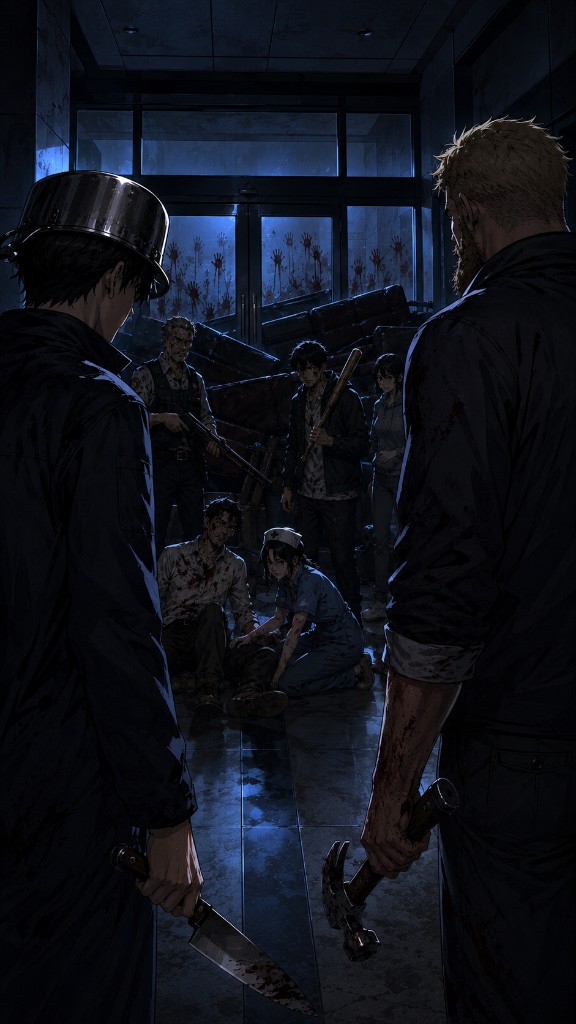
The lobby of the building was a wide, open space with a marble floor, a front desk, a row of mailboxes along one wall, and floor-to-ceiling windows that looked out onto the street. The windows were intact but smeared with something on the outside, dark handprints and long, dragging smears, as if things had pressed themselves against the glass and then been pulled away.
The front doors were barricaded. Someone had dragged the lobby's heavy leather couches across the entrance and stacked them against the glass, then reinforced the pile with the front desk itself, a massive slab of granite-topped oak that must have taken three or four people to move. Filing cabinets were wedged into the gaps. A vending machine had been tipped onto its side and shoved against the base of the barricade, its glass front shattered, snacks scattered across the marble.
It was crude. It was ugly. But it was solid.
Ten people stood or sat in the lobby. Some of them looked up when Marco and I emerged from the stairwell. Others didn't move.
I scanned them.
A man in his fifties, gray-haired, wearing a security guard uniform. He had a holstered pistol on his hip and a shotgun leaning against the wall beside him. His name tag read PARK. He stood near the barricade with his arms crossed, watching the street through a gap in the couches.
That's the shooter.
Next to him, a young man, early twenties, lean and sharp-featured, wearing a leather jacket over a band t-shirt. He had a baseball bat resting across his knees and a lit cigarette in the corner of his mouth, the smoke curling up toward the lobby's high ceiling. He sat on the overturned vending machine with the casual slouch of someone who was either very brave or very stupid.
A woman in nurse's scrubs, mid-thirties, her dark hair pulled back in a messy bun. She was kneeling beside a man who lay on the marble floor with his back propped against the mailboxes. His left arm was wrapped in what looked like strips of a bedsheet, already soaked through with red. Real red. Human red. She worked on the bandage with quick, practiced hands. Her face was blank, the professional mask of someone who'd seen worse in an ER.
An older couple sat together on the floor near the elevator bank, their backs against the wall. The man had his arm around the woman. They were both in their seventies, dressed for a morning walk that had never happened. He wore a flat cap and a windbreaker. She clutched a small leather purse against her chest as if it contained everything that mattered. Neither of them spoke.
A teenager, sixteen or seventeen, sat alone in the corner farthest from the barricade. Hoodie, headphones around his neck, knees drawn up. He was staring at his phone, which was dark and dead, but he stared at it anyway, as if looking at the blank screen was better than looking at anything else in the room.
A tall woman in athletic wear stood near the stairwell door we'd just come through. She had a fire extinguisher in one hand and a look on her face that said she'd already used it on something that wasn't a fire. Short blonde hair. Hard eyes. She looked at Marco and me and her grip on the extinguisher tightened before she registered that we were alive and walking upright.
And at the far end of the lobby, sitting on the floor with her knees pulled to her chest and her arms wrapped around her shins, staring at nothing—
The woman from the fifteenth floor. Dark hair. Tank top and pajama shorts. Danny's wife.
She looked up when I came down the last step. Her eyes found me across the lobby and the recognition was instant, a flash of heat that hardened her whole face.
I held her gaze for one second. Then I looked away.
Ten survivors. Ten people in a twenty-story building that held, what, two hundred? Three hundred residents?
Marco stepped forward into the lobby, hammer at his side, and the room shifted. Conversations stopped. Eyes turned. The security guard straightened. The kid with the baseball bat took the cigarette from his mouth.
"My name's Marco Reeds," he said. His voice carried without effort. "Twentieth floor. This is Scott, fifteenth floor. He helped me when they got past my door."
He let that sit for a moment.
"We came down to find out who's left. So." He looked around the room. "Who's left?"